
Maths Extended: Inverse Functions with a Real-World Taxi Fare Problem
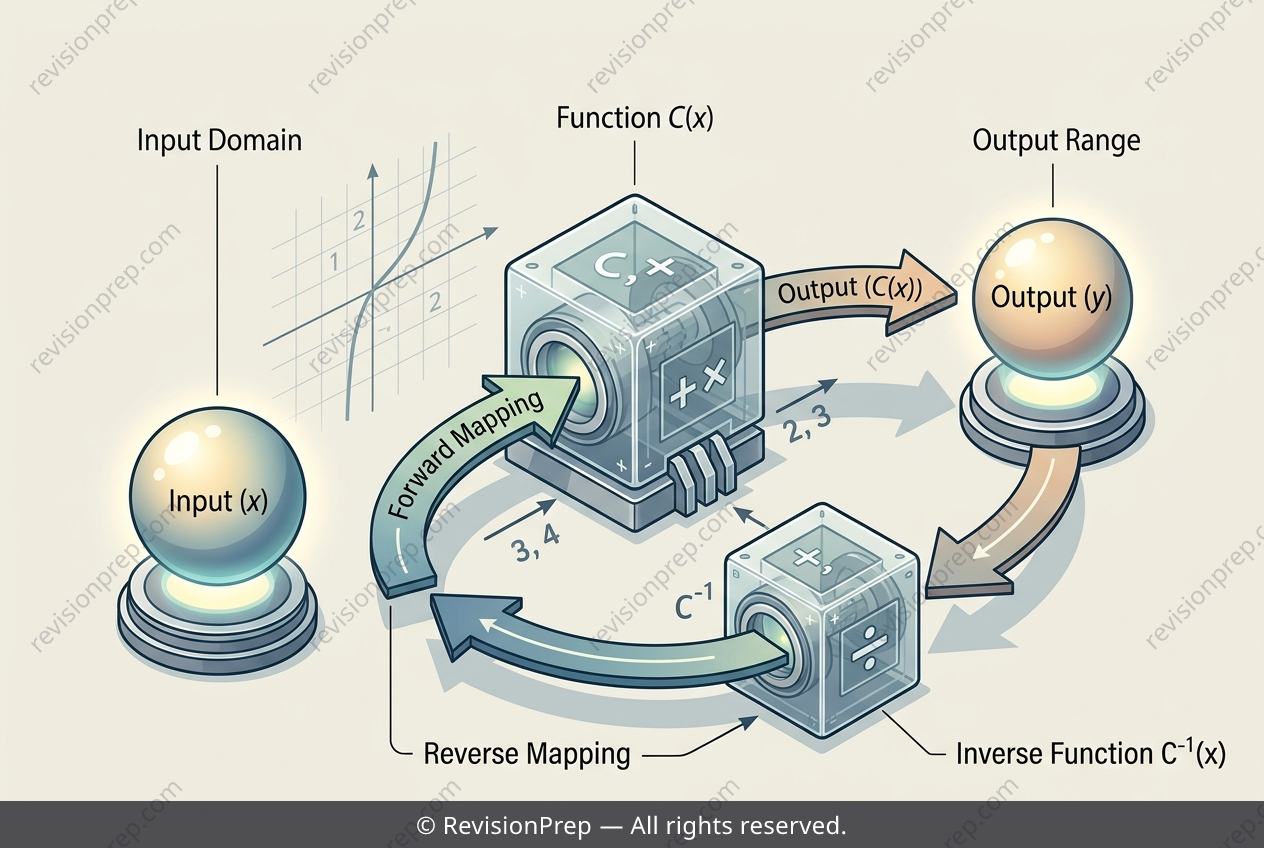
Functions and inverse functions are two sides of the same coin: a function maps an input to an output, while its inverse undoes that mapping, returning you to the original input. In the context of real-world modelling, this relationship is not just abstract—it is the key to moving fluidly between a quantity and its consequences. For instance, a linear cost function like C(d) = 2.1d + 3.5 tells you the total fare for any distance d, but its inverse, C⁻¹, lets you ask the reverse question: given a fixed budget, what is the maximum distance you can travel? This dual perspective is powerful because it connects two ways of reasoning about the same constraint. When you evaluate C(8), you are checking the cost of a specific journey; when you compute C⁻¹(20), you are finding the distance limit for a given price. The marking scheme highlights that both approaches must agree—if the cost at 8 km exceeds the budget, or equivalently, if 8 km is greater than the inverse’s result, the conclusion is the same. Understanding this symmetry between a function and its inverse not only solves the problem but reveals the underlying structure of many practical calculations, from taxi fares to currency exchange.
Start practising IB questions today
150,000+ IB-styled questions, criteria-mapped and instantly accessible.