
Maths Extended: Master Break-Even Analysis and Price Sensitivity in IB Math
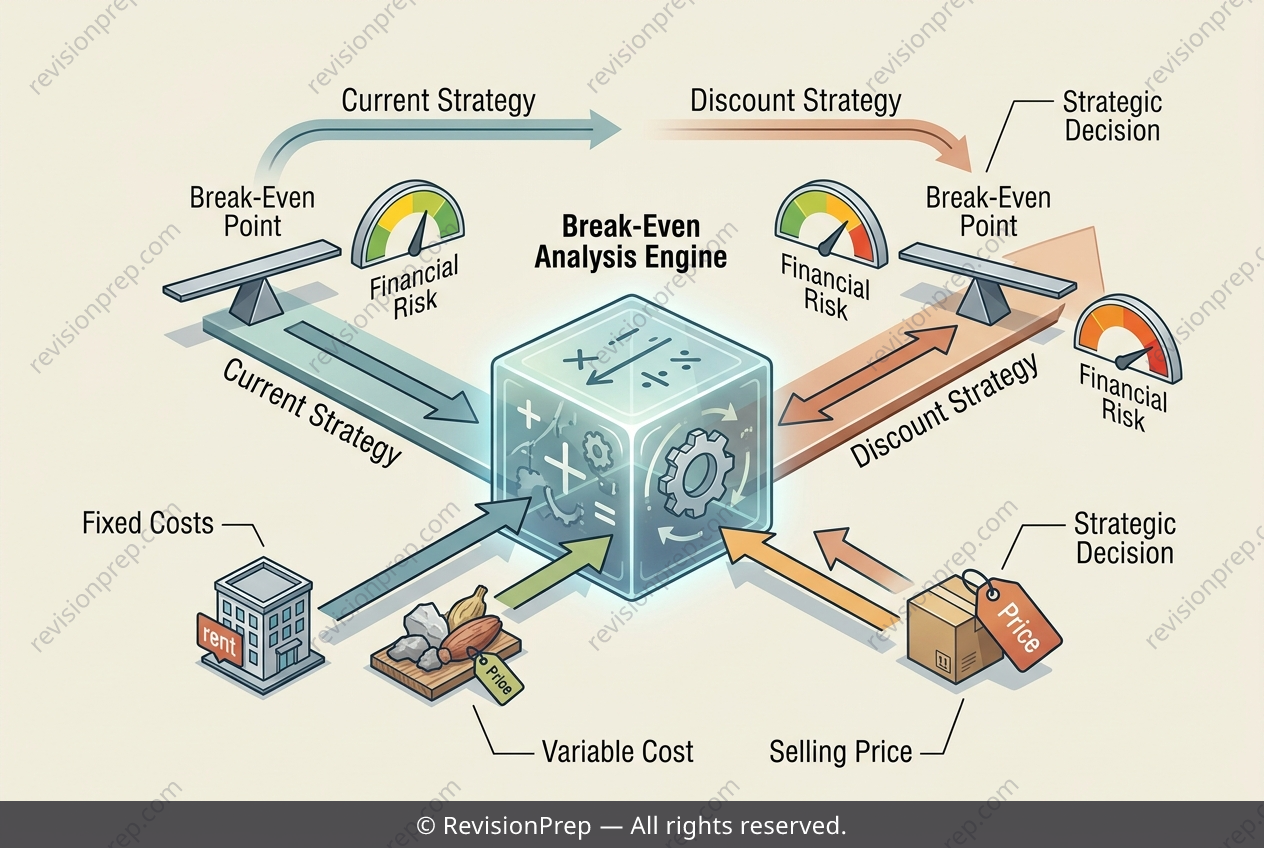
Break-even analysis is the point where total costs exactly equal total revenue—the moment a business stops losing money and starts covering its expenses. For any company, this is the financial threshold that separates survival from failure, and for students studying applications of functions, it is a perfect real-world example of solving linear equations. In this case, a candle maker faces fixed monthly costs (rent, salaries) and variable costs per candle produced, while earning a fixed selling price per unit. The cost function combines both fixed and variable components, while the revenue function is simply price multiplied by quantity. The power of break-even analysis lies in its sensitivity to price changes. When the selling price drops—say, due to a discount—the contribution margin (price minus variable cost) shrinks, meaning each candle contributes less toward covering fixed costs. Consequently, the break-even quantity rises, often dramatically. This relationship is not just arithmetic; it reveals strategic trade-offs. A small price cut may require a large increase in sales volume just to stay profitable. By comparing the original and discounted break-even points, students see how functions model business decisions, and why understanding the slope of each line—cost versus revenue—matters for real-world risk assessment.
Start practising IB questions today
150,000+ IB-styled questions, criteria-mapped and instantly accessible.