
Maths Extended: Maximizing Quadratic Revenue: Modeling Price vs. Sales Limits
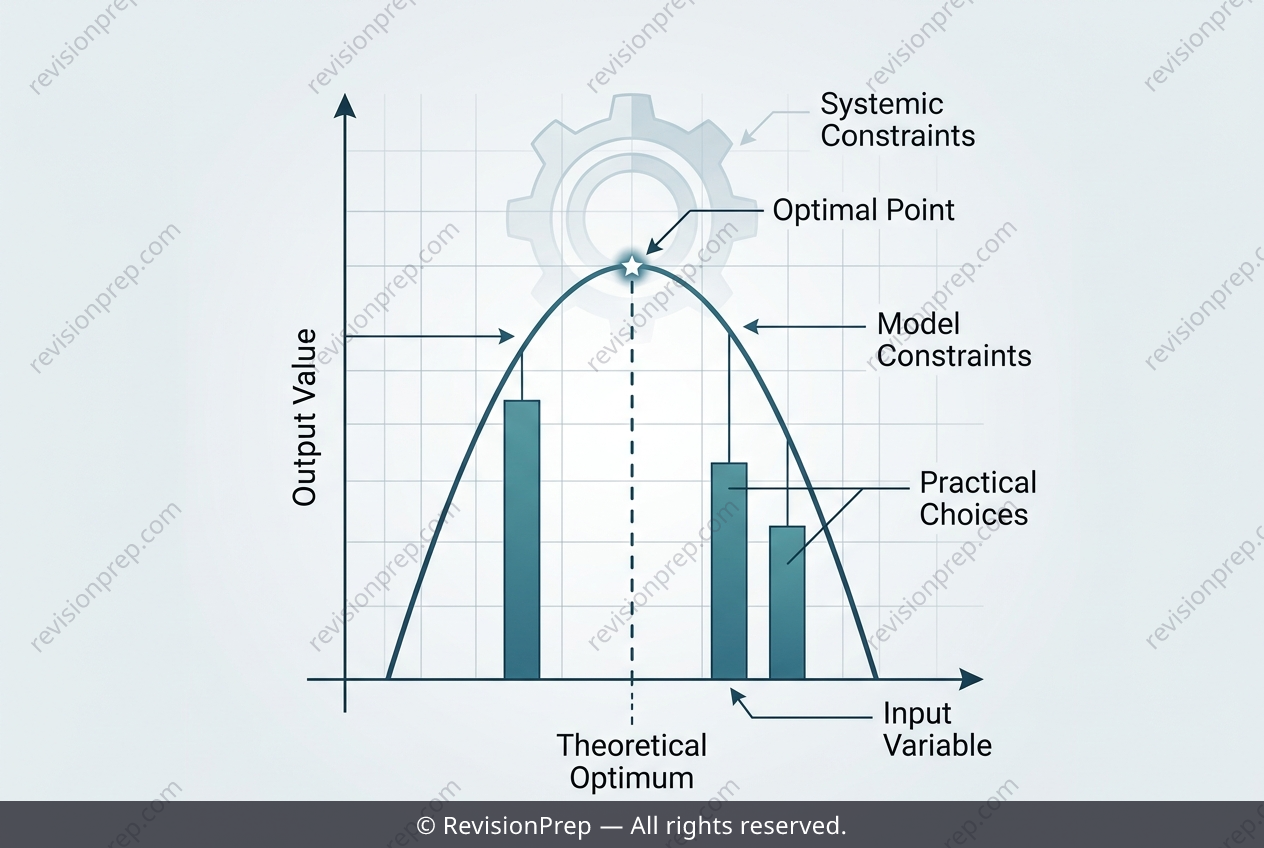
Quadratic functions are more than just curves on a page—they are tools for making real-world decisions. In this case, a bakery’s daily revenue can be modelled as a quadratic function of the number of price increases, where each increase raises the price per cupcake but also drives away customers. The core idea is that revenue is the product of price and quantity sold, so as one rises and the other falls, the relationship forms a parabola. This shape reveals a single peak—the maximum revenue—found at the vertex of the curve, using the formula x = -b/(2a) after expanding the function into standard form ax² + bx + c. What makes this concept powerful is its connection between algebra and practical limits. The vertex gives the mathematically optimal price, but real-world constraints—like only being able to set prices in fixed increments—mean the bakery must evaluate nearby integer values of x. Interestingly, two different prices can yield identical revenue, highlighting a key limitation: the model assumes a perfectly linear drop in customers, which may not hold in reality. Understanding this balance between optimisation and model assumptions is essential for applying quadratics beyond the classroom, from pricing strategies to profit forecasting.
Start practising IB questions today
150,000+ IB-styled questions, criteria-mapped and instantly accessible.