
Maths Extended: Modeling Assumptions: Testing Cost Functions Beyond the Data
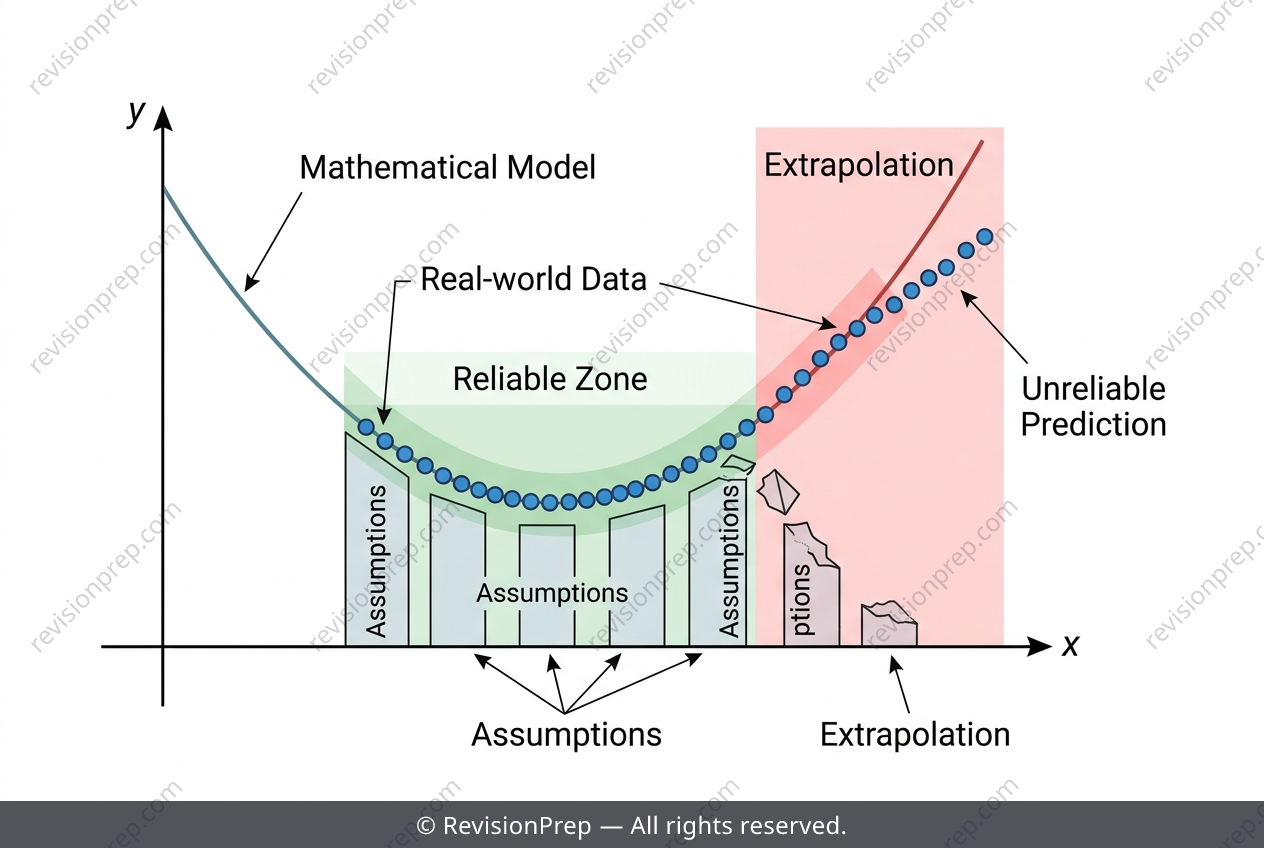
Mathematical modeling is the art of translating a real-world situation into a mathematical form, then using that form to make predictions. In this case, a courier company’s delivery cost is expressed as a quadratic function of distance: C(d) = 0.05d² + 2d + 10. This single equation packs in several assumptions about how costs behave—some explicit, like the fixed base fee of 10 dollars, and some hidden, like the claim that costs accelerate as distance grows. Why does this matter? Because a model is only as good as its assumptions. For short trips, the quadratic term is small, and the linear and constant parts dominate, giving reasonable estimates. But when you plug in a very large distance—say, 500 km—the 0.05d² term explodes, contributing thousands of dollars. The marking scheme highlights that this quadratic growth assumes cost-per-kilometre increases with distance, which is unrealistic for fuel (usually roughly constant). It also ignores real long-haul expenses like driver rest stops or tolls. So the model’s reliability collapses at extremes: it overestimates some costs while underestimating others. Understanding these connections—between the formula’s shape, its underlying assumptions, and the domain of validity—is the core of evaluating any mathematical model.
Start practising IB questions today
150,000+ IB-styled questions, criteria-mapped and instantly accessible.