
Maths Extended: Quadratic Functions: Analyzing Maximum Height and Motion
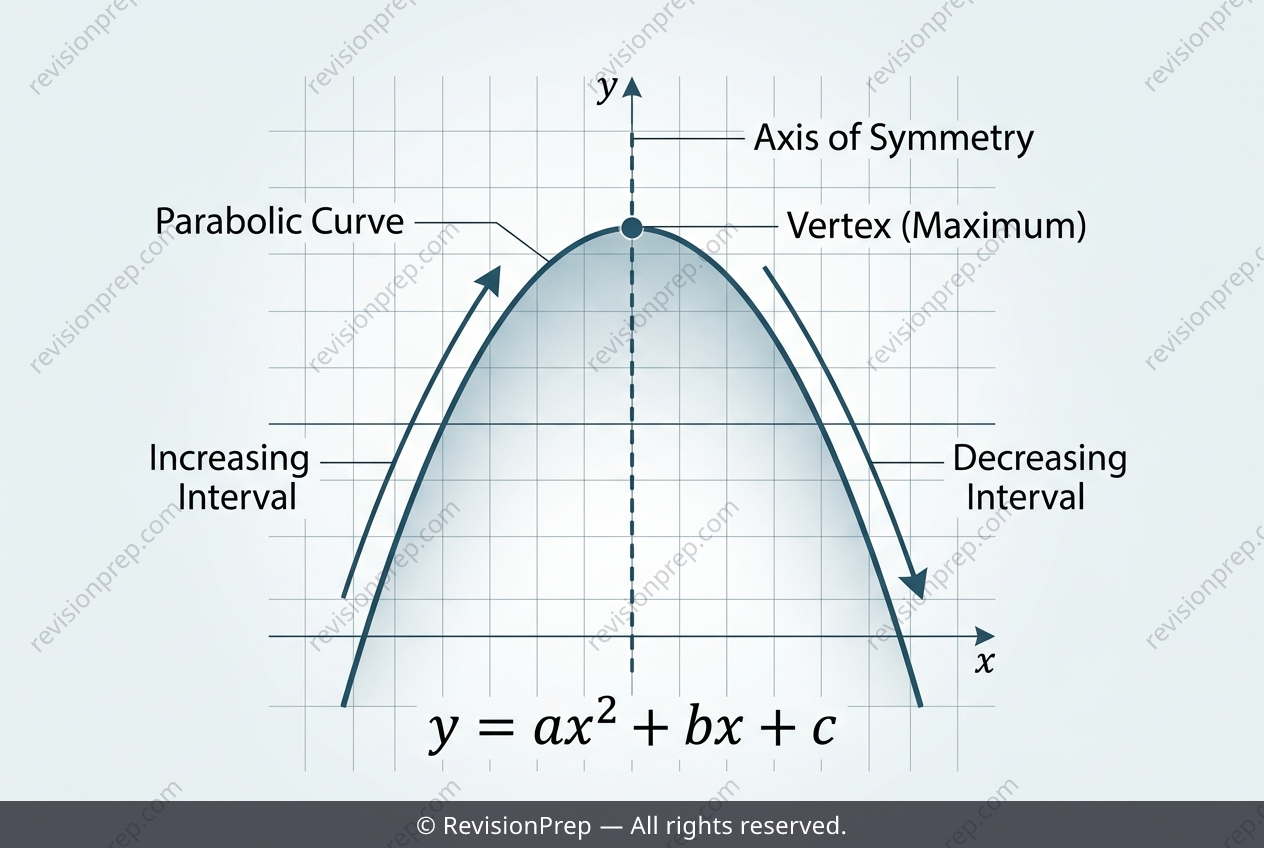
Quadratic functions are the mathematical language of symmetrical motion, and this question uses one to model the flight of a basketball free throw. At its heart, the topic asks you to connect the algebraic form of a parabola—specifically, a function like h(t) = at² + bt + c—to its physical meaning: the height of the ball over time. The key relationship here is that the vertex of the parabola, found using the axis of symmetry t = -b/(2a), gives the exact moment when the ball stops rising and begins to fall, making it the peak of the trajectory. Why does this matter? Because real-world questions rarely ask for a single value; they ask you to interpret motion. By comparing the time at which the ball reaches a given height (like the rim) to the time of the vertex, you can determine whether the ball is still on its way up or already descending. The marking scheme highlights this: solving h(t) = 3.05 yields two times, and the smaller one, being less than the axis of symmetry, proves the ball is still rising. This connects the formula for the vertex, the quadratic formula for roots, and the concept of monotonic intervals—showing how one algebraic tool informs another to build a complete physical picture.
Start practising IB questions today
150,000+ IB-styled questions, criteria-mapped and instantly accessible.