
Maths Extended: Quadratic Optimization with a Classic Fencing Problem
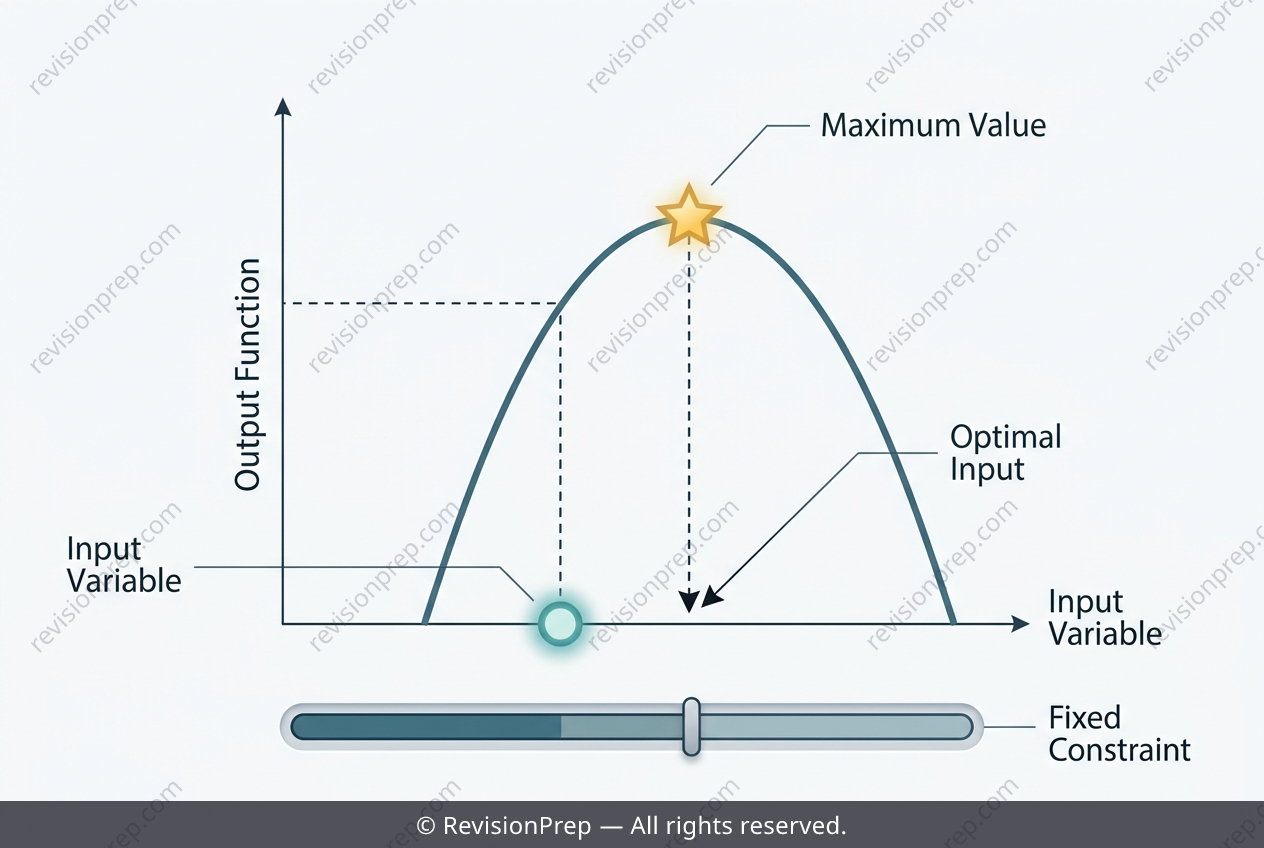
Quadratic functions are more than just curves on a page—they are powerful tools for describing real-world situations where you want to find the best possible outcome, such as the largest area you can enclose with a fixed amount of material. In this classic optimisation problem, a farmer uses 60 metres of fencing to build a rectangular paddock against an existing stone wall, meaning only three sides need fencing. The key relationship emerges from the constraint: if the width perpendicular to the wall is x, then the side parallel to the wall must be 60 − 2x, giving the area as A(x) = x(60 − 2x), or expanded, A(x) = −2x² + 60x. The heart of the concept lies in recognising that this quadratic opens downward (since the coefficient of x² is negative), so its vertex represents the maximum area. The axis of symmetry formula, x = −b/(2a), with a = −2 and b = 60, pinpoints exactly where that peak occurs. Substituting this x back into the area expression reveals the greatest possible area the fencing can achieve. This connection between the algebraic form, the geometric constraint, and the practical limit is what makes optimisation so useful—it turns a “how big can I make it?” question into a precise, calculable answer. Understanding this process lets you evaluate claims like “at least 500 m²” against the mathematical ceiling, showing whether a requirement is feasible or simply impossible with the given resources.
Start practising IB questions today
150,000+ IB-styled questions, criteria-mapped and instantly accessible.