
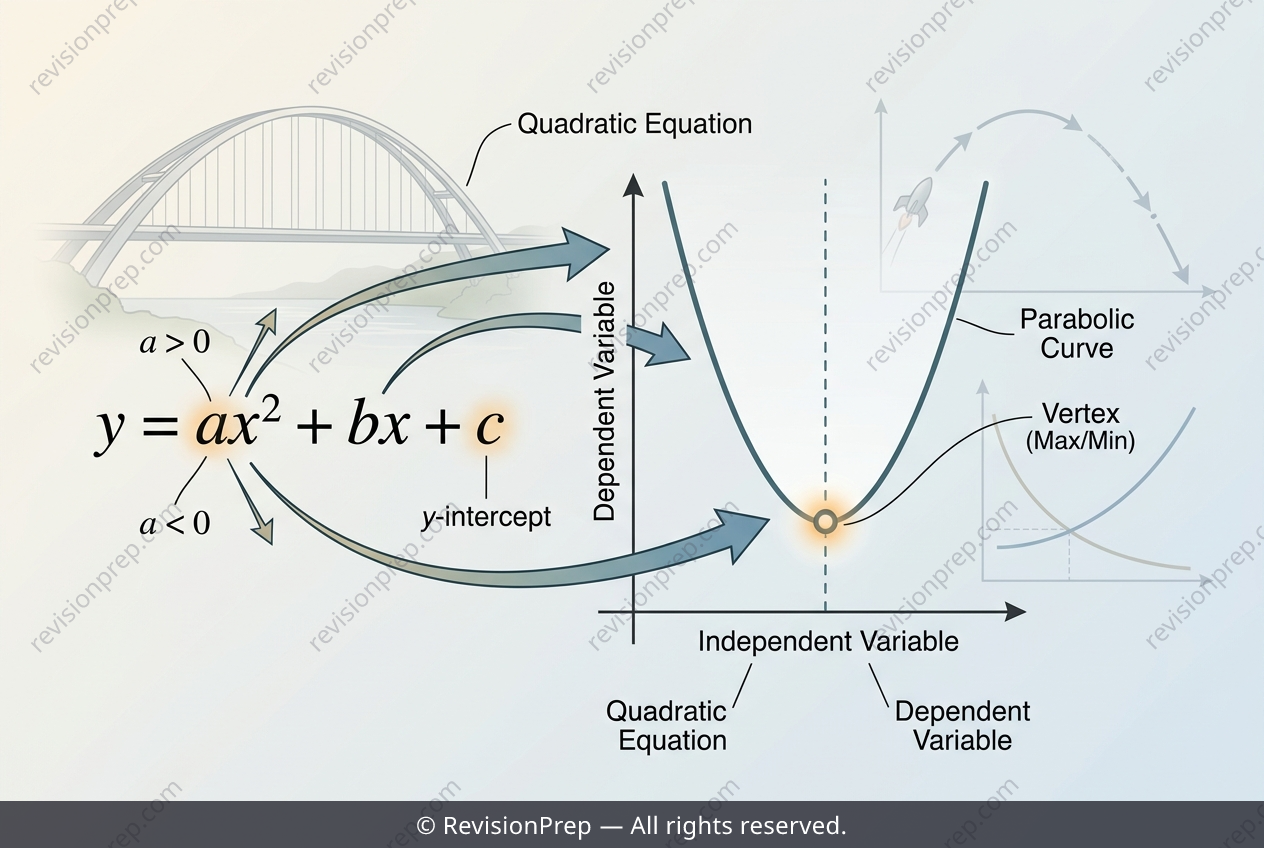
Maths Extended: Quadratic Vertex Problems: Drone Flight Path Optimization
Quadratic functions are far more than abstract parabolas on a page—they are the mathematical language of motion, profit, and design. At their heart lies a single, powerful idea: the vertex, the point where a curve reaches its peak or trough. For any quadratic written in the form h(t) = at² + bt + c, the axis of symmetry formula t = -b/(2a) pinpoints the exact moment this turning point occurs. This is not just a neat trick; it is the key to solving real-world optimisation problems, from finding the maximum height of a projectile to determining the most profitable production level. The true value of this concept emerges when you connect the parts. Once you locate the time of the vertex, you substitute it back into the original equation to find the corresponding maximum (or minimum) value. This two-step process—first find the critical input, then evaluate the output—forms the backbone of critical point determination. In contexts like flight paths or bridge arches, this calculated peak is then compared against real-world constraints, such as a clearance threshold. The relationship between the algebraic vertex and the physical limit is what turns a simple calculation into a safety decision, revealing whether a theoretical model holds up under practical scrutiny.
Start practising IB questions today
150,000+ IB-styled questions, criteria-mapped and instantly accessible.