
Maths: From 10 to 500 Flips: Understanding the Law of Large Numbers
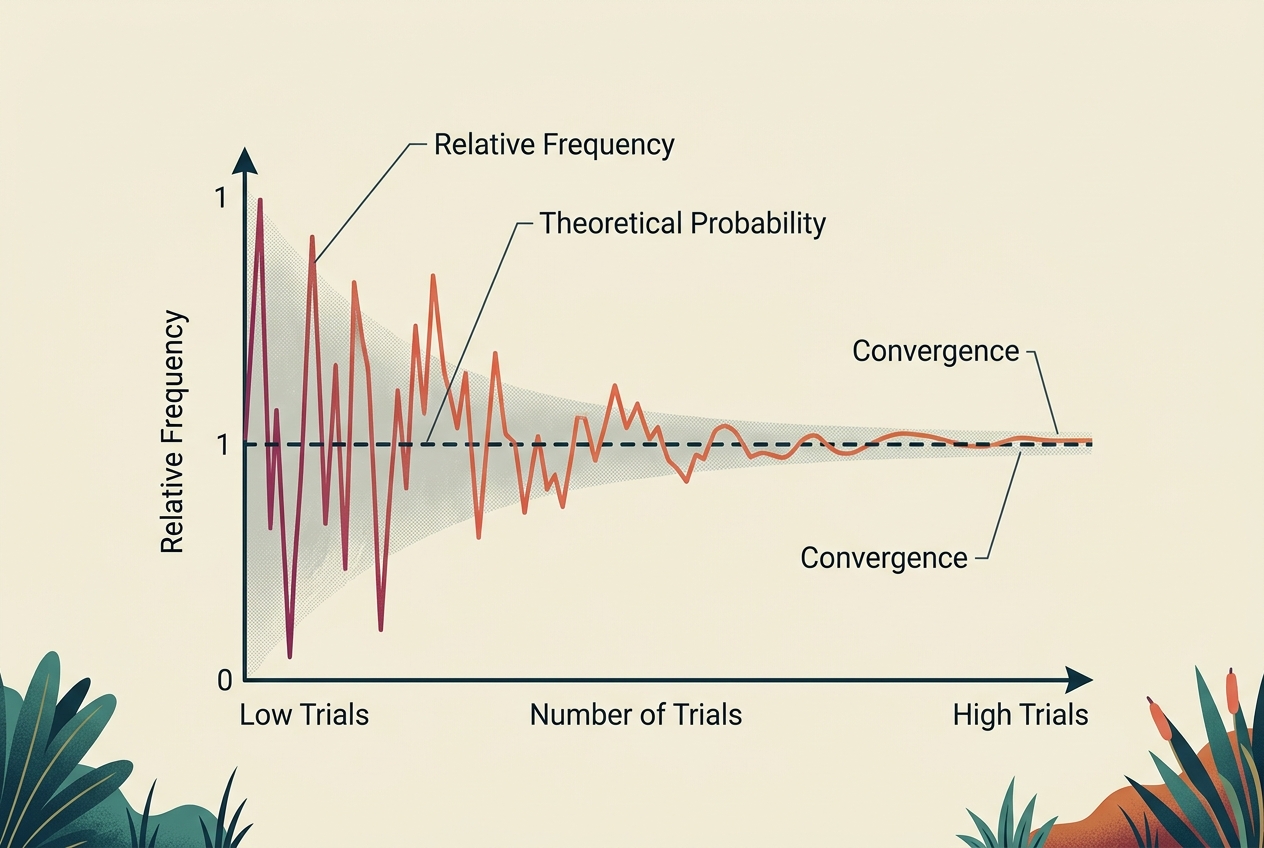
Probability is not always what it seems at first glance. In mathematics, the distinction between experimental and theoretical probability lies at the heart of understanding randomness, and the Law of Large Numbers is the bridge that connects them. When a student flips a fair coin only 10 times and sees 4 heads, the relative frequency—calculated as the frequency of the event divided by the total number of trials—gives 0.4. But this is just a snapshot of chance, not the true probability. The theoretical probability for a fair coin remains 0.5, and the key question is: how do we reconcile these two numbers? This is where the Law of Large Numbers becomes essential. It states that as the number of trials increases, the relative frequency of an event converges to its theoretical probability. In other words, small samples are vulnerable to random variation—10 flips can easily produce a result far from 0.5—but with many trials, like 500 flips, the relative frequency will settle close to the true value. This principle explains why a single small experiment can mislead, while a larger dataset provides a reliable estimate. Understanding this relationship helps us critically evaluate claims based on limited evidence and appreciate how probability governs real-world phenomena, from coin tosses to quality control in manufacturing.
Start practising IB questions today
150,000+ IB-styled questions, criteria-mapped and instantly accessible.