
Maths: Geometric Similarity: Scale Factors in Real-World Problems
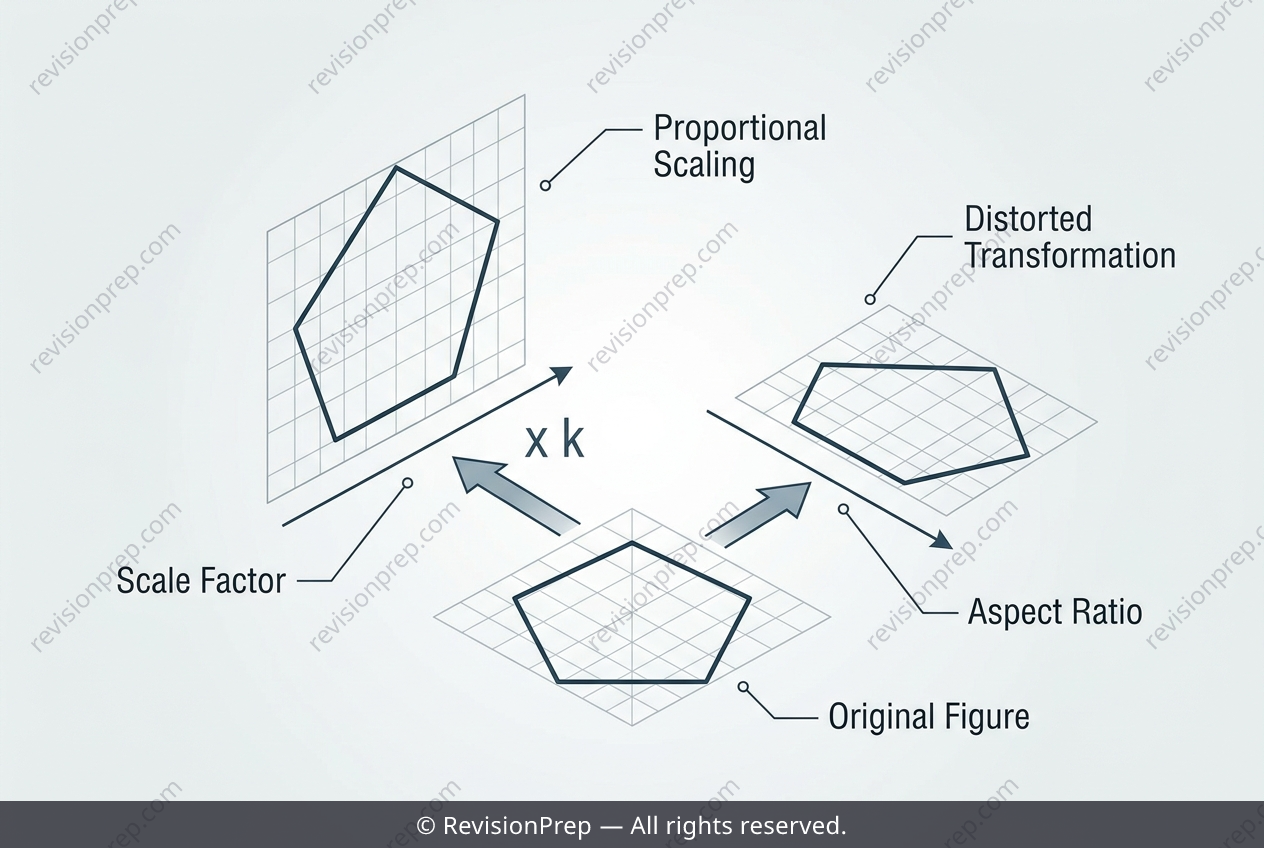
When two shapes are mathematically similar, they share the exact same proportions, even if their sizes differ. This is the heart of geometric similarity: every corresponding length is multiplied by the same scale factor, while every angle remains unchanged. In practical terms, if you know the ratio between one pair of matching sides, you can predict the size of every other side in the enlarged or reduced figure. This idea becomes immediately useful in real-world contexts like resizing photographs. A photo and a frame are similar only if their width-to-height ratios match. The scale factor is found by dividing any new length by its corresponding original length—for instance, new width divided by original width, or new height divided by original height. If the ratios match, the enlargement is faithful and the image keeps its shape. However, if the frame’s proportions differ from the photo’s, the scale factor is not uniform across dimensions. The result is distortion: a face may appear stretched horizontally or squashed vertically. Beyond shape distortion, a large scale factor can also reveal pixelation or blurriness, since the original detail is spread over a much larger area. Understanding similarity thus helps you predict not just size, but visual fidelity.
Start practising IB questions today
150,000+ IB-styled questions, criteria-mapped and instantly accessible.