
Maths HL: Composite Functions with Exponential and Logarithmic Inverses
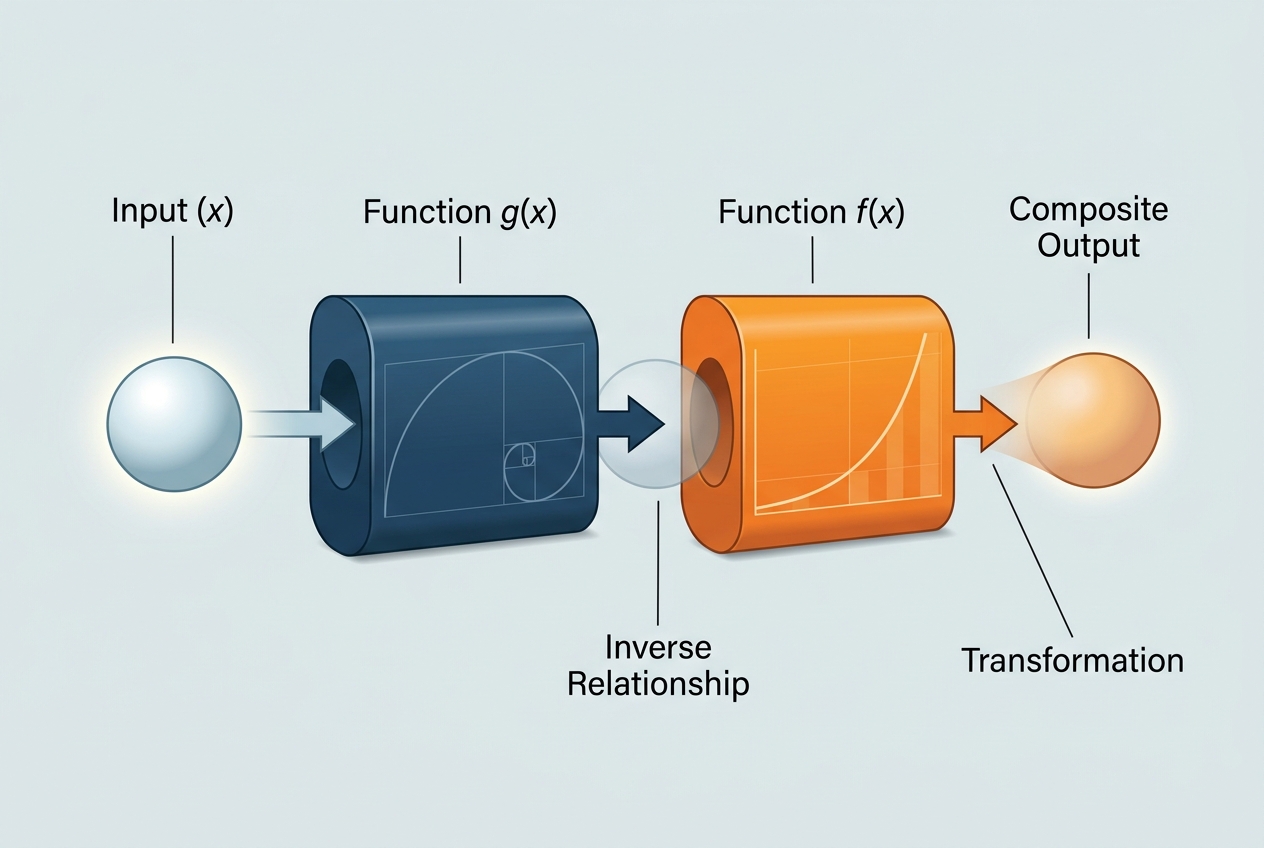
Composite functions are a foundational concept in mathematics, where the output of one function becomes the input of another, creating a chain of operations that can reveal deeper relationships between different types of functions. In this topic, we explore how exponential and logarithmic functions interact through composition, specifically when f(x) = e^(x+1) and g(x) = ln(x). Understanding this interplay is crucial because it demonstrates how inverse operations can simplify complex expressions—here, the natural logarithm and the exponential function are inverses, so their composition cancels out the base operations, leaving behind a simple linear relationship. The key mechanism lies in the algebraic simplification of f(g(x)). When you substitute g(x) = ln(x) into f, you obtain e^(ln(x) + 1), which can be rewritten as e^(ln(x)) * e^1. Since e^(ln(x)) equals x for x > 0, the composite reduces to e * x. This transformation highlights how the structure of the functions determines their combined behavior: the exponential’s shift by +1 becomes a multiplicative factor of e. As a result, for any positive x, the composite output is always larger than the input, because e ≈ 2.718 > 1. This example illustrates how analyzing composite functions often involves simplifying nested expressions using inverse properties, revealing a direct proportionality that governs the output’s relationship to the input.
Start practising IB questions today
150,000+ IB-styled questions, criteria-mapped and instantly accessible.