
Maths: How Uncertainty Affects Sin and Cos Rule Triangulation
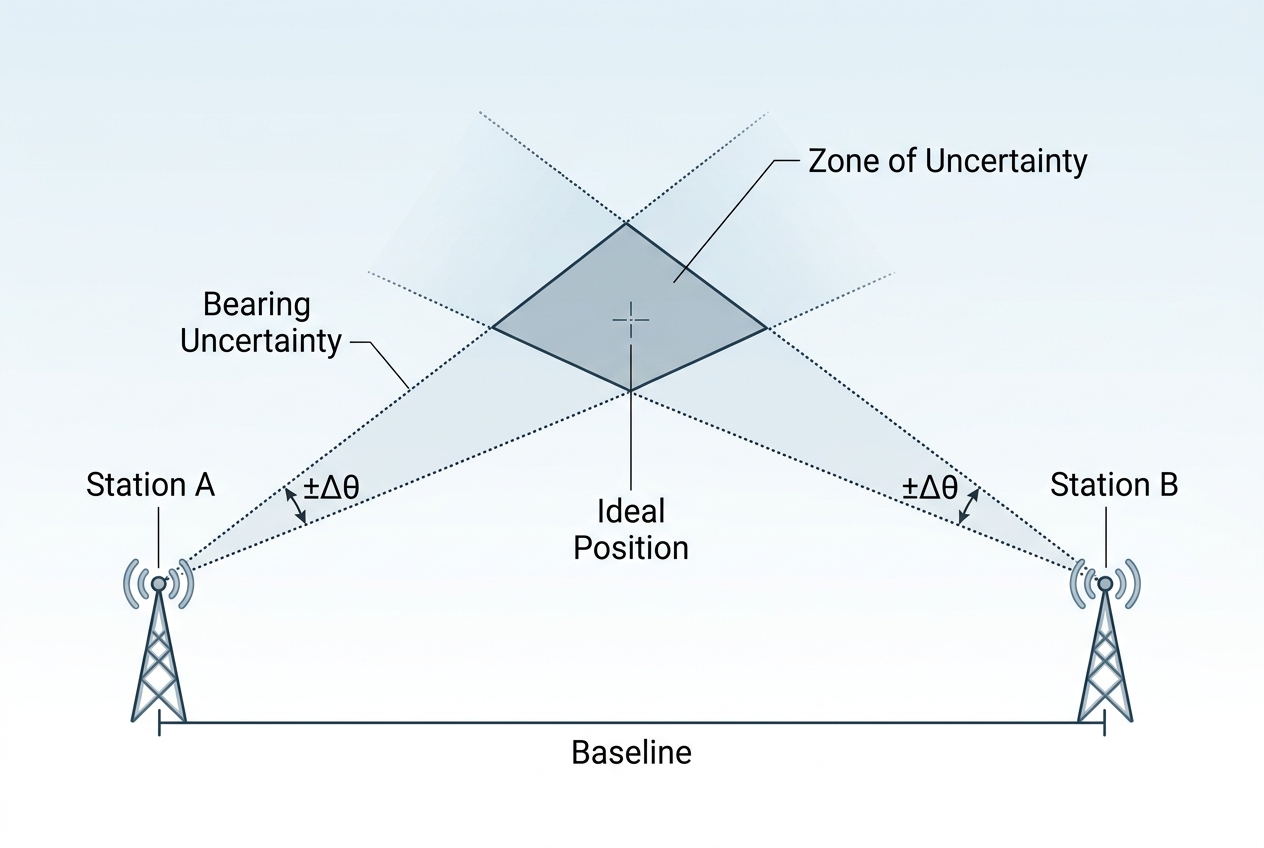
When a single measurement isn’t enough, triangulation uses geometry to pinpoint a location—but what happens when your angles come with a margin of error? In this problem, two search-and-rescue stations 50 km apart record bearings of a distress signal as 30° and 50° from the coastline, each with a ±1° uncertainty. The core concept is uncertainty analysis in geometric triangulation: how small errors in measured angles propagate through the Law of Sines to affect a calculated distance. The triangle formed by the two stations and the signal has interior angles determined by the bearings, with the third angle found by subtracting from 180°. Applying the Law of Sines—side over sine of opposite angle—gives the distance from station A to the signal. By testing worst-case combinations of the bearing errors (e.g., 29° and 51°, or 31° and 49°), you can deduce the maximum possible range of that distance. This reveals how a ±1° equipment limitation translates into a potentially dangerous uncertainty band in the field, especially when directing rescue vessels in rough, low-visibility conditions.
Start practising IB questions today
150,000+ IB-styled questions, criteria-mapped and instantly accessible.