
Maths: Inverse Proportion with Real-World Travel Time Assumptions
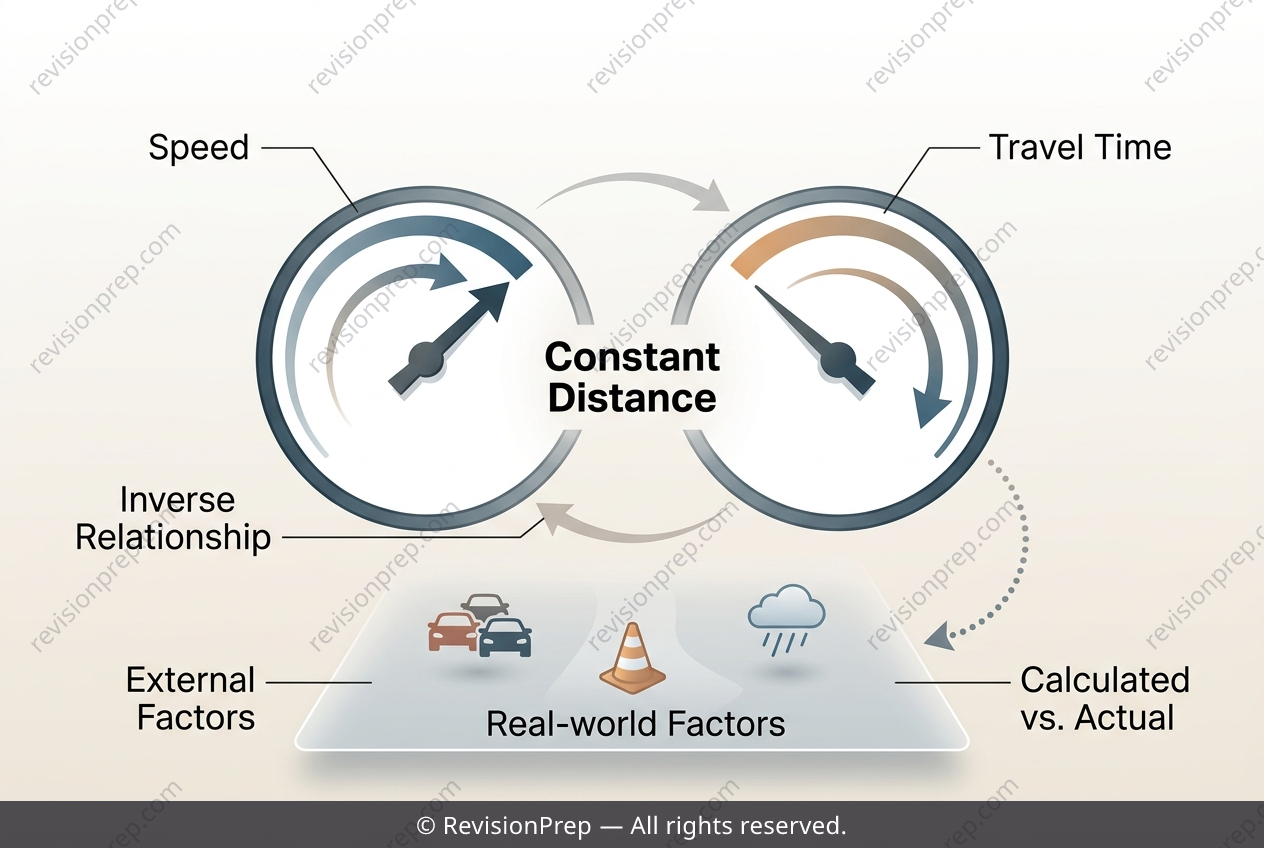
Inverse proportionality describes a relationship where one quantity increases as another decreases, and vice versa, such that their product remains constant. In this context, when distance is fixed, speed and time are inversely proportional: if you travel faster, the journey takes less time, and if you travel slower, it takes more. This relationship is captured by the formula time = distance ÷ speed, which forms the backbone of many real-world mathematical models. Understanding this concept matters because it moves beyond simple arithmetic into the realm of assumptions and limitations. The neat calculation assumes a constant speed maintained for the entire journey, but reality is rarely so uniform. Traffic congestion, speed limits, road works, or even rest stops all disrupt the idealised model, meaning the actual time will almost always differ from the theoretical value. By exploring both the clean mathematical relationship and the reasons it breaks down in practice, you learn to appreciate how models simplify the world—and where those simplifications fail. This dual perspective is essential for applying mathematics to everyday situations, from planning trips to analysing rates of change in science and economics.
Start practising IB questions today
150,000+ IB-styled questions, criteria-mapped and instantly accessible.