
Maths: Like Terms: A Real-World Receipt Approach
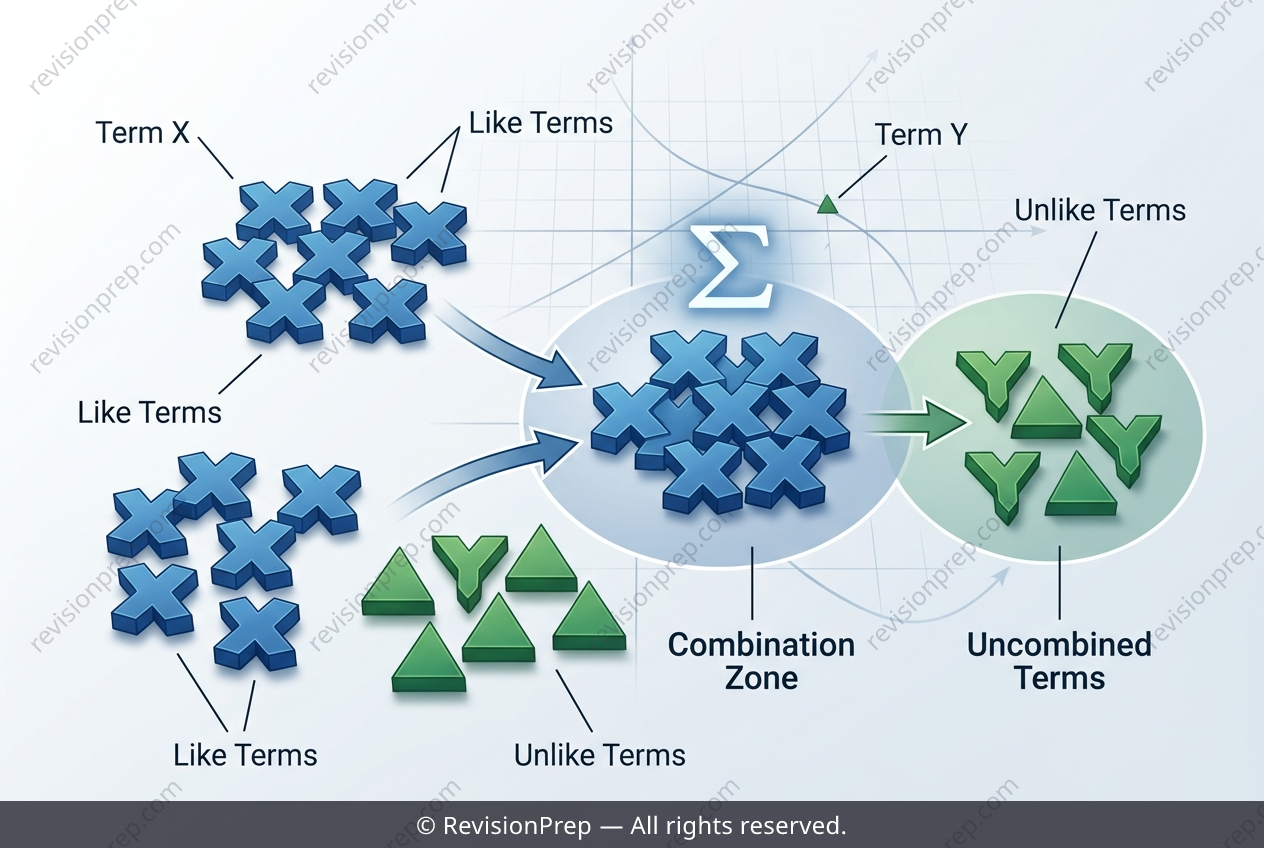
In algebra, variables and constants are the building blocks of expressions, but their real power emerges when we learn to sort and combine them efficiently. At its heart, this lesson is about recognizing which pieces of a mathematical statement are “alike” and which are fundamentally different—a skill that turns messy sums into clean, meaningful totals. Think of a shopping receipt: each fruit type represents a distinct term. Like terms share the same variable (or item), so they can be added or subtracted directly, just as two separate apple entries on a receipt can be merged into one total. Unlike terms—apples, bananas, grapes—represent different variables, and combining them would blur the distinction between quantities, producing a result that lacks practical meaning. The marking scheme emphasizes that identifying like terms requires both recognizing their shared identity and performing the arithmetic, while rejecting a combination of unlike terms demands a reason tied to usefulness. This distinction—between what can be merged and what must stay separate—is the core mechanism behind simplifying expressions, solving equations, and interpreting real-world data without losing track of what each number actually represents.
Start practising IB questions today
150,000+ IB-styled questions, criteria-mapped and instantly accessible.