
Maths: Like Terms: Simplifying Algebraic Expressions in IB Math
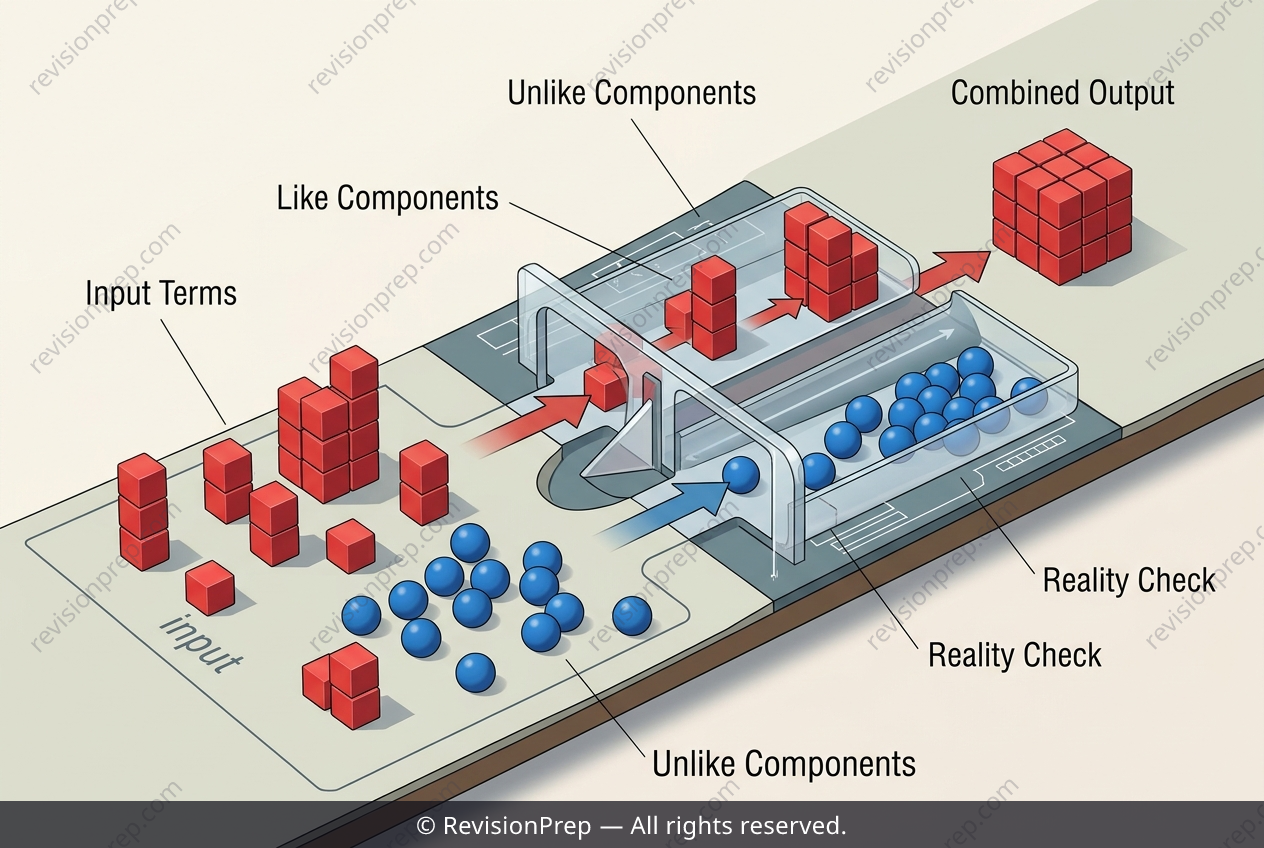
Algebraic expressions are the building blocks of mathematical modelling, letting us translate real-world situations into compact, manipulable forms. At the heart of this lies the distinction between variables—symbols that stand for unknown or changing quantities—and constants, which remain fixed. When we write an expression like 3a + 2b + 5a, the letters represent per-unit costs, while the numbers in front of them (coefficients) tell us how many units we’re dealing with. Understanding how these parts interact is essential for simplifying expressions correctly and for checking whether a model’s assumptions hold up in practice. The key relationship here is the concept of “like terms”: terms are considered alike when they share the exact same variable part, regardless of their coefficients. This means 3a and 5a are like terms because both contain the variable a to the first power—the coefficients 3 and 5 are irrelevant to that classification. Simplification then becomes a matter of combining these like terms by adding their coefficients, yielding a single term that preserves the variable. However, simplification is only valid if the model’s assumptions are sound—for instance, assuming a fixed price per kilogram. If real-world factors like bulk discounts alter that price, the simplified expression may no longer reflect reality, highlighting the delicate link between algebra and the assumptions we build into our models.
Start practising IB questions today
150,000+ IB-styled questions, criteria-mapped and instantly accessible.