
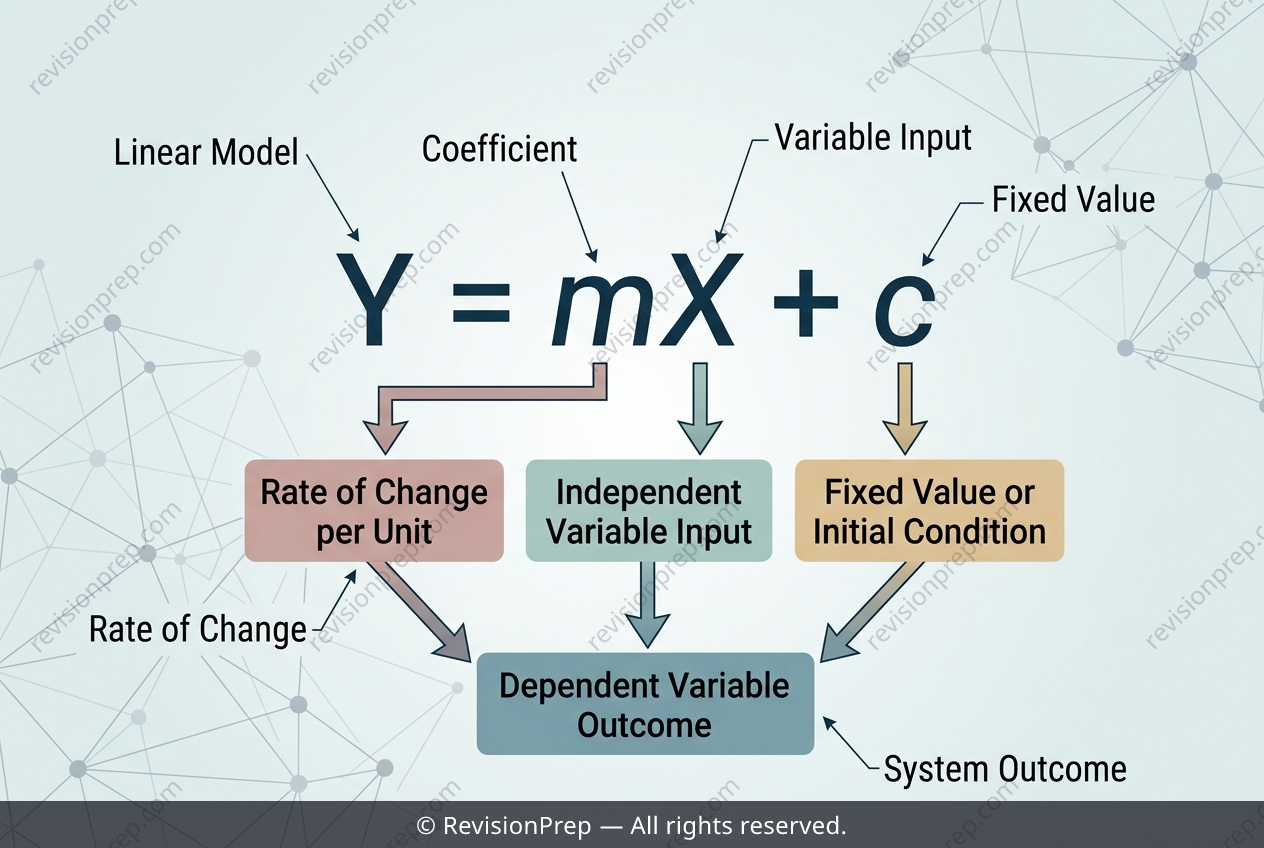
Maths: Linear Algebraic Modeling: Interpreting and Calculating Profit
Algebraic expressions are the language we use to translate real-world situations into mathematics. In this case, a café’s daily profit is captured by the simple linear model 3.50x − 25, where x represents the number of smoothies sold. The power of this expression lies in its two distinct parts: the coefficient 3.50 and the constant term −25. Together, they encode both the variable and fixed components of the business’s finances. Understanding how to interpret and manipulate such expressions is foundational for IB Mathematics, because it bridges abstract algebra with practical decision-making. Here, 3.50 represents the profit earned per smoothie — the marginal contribution of each additional sale — while −25 represents a fixed daily cost, an expense incurred regardless of sales volume. This structure mirrors the general form of a linear function, where the slope (3.50) drives growth and the intercept (−25) sets the starting point. By substituting a value for x, you can calculate the resulting profit, but more importantly, you learn to see how each term contributes to the whole — a skill that applies far beyond cafés, from engineering to economics.
Start practising IB questions today
150,000+ IB-styled questions, criteria-mapped and instantly accessible.