
Maths: Linear Cost-Revenue-Profit Models with Variables and Constants
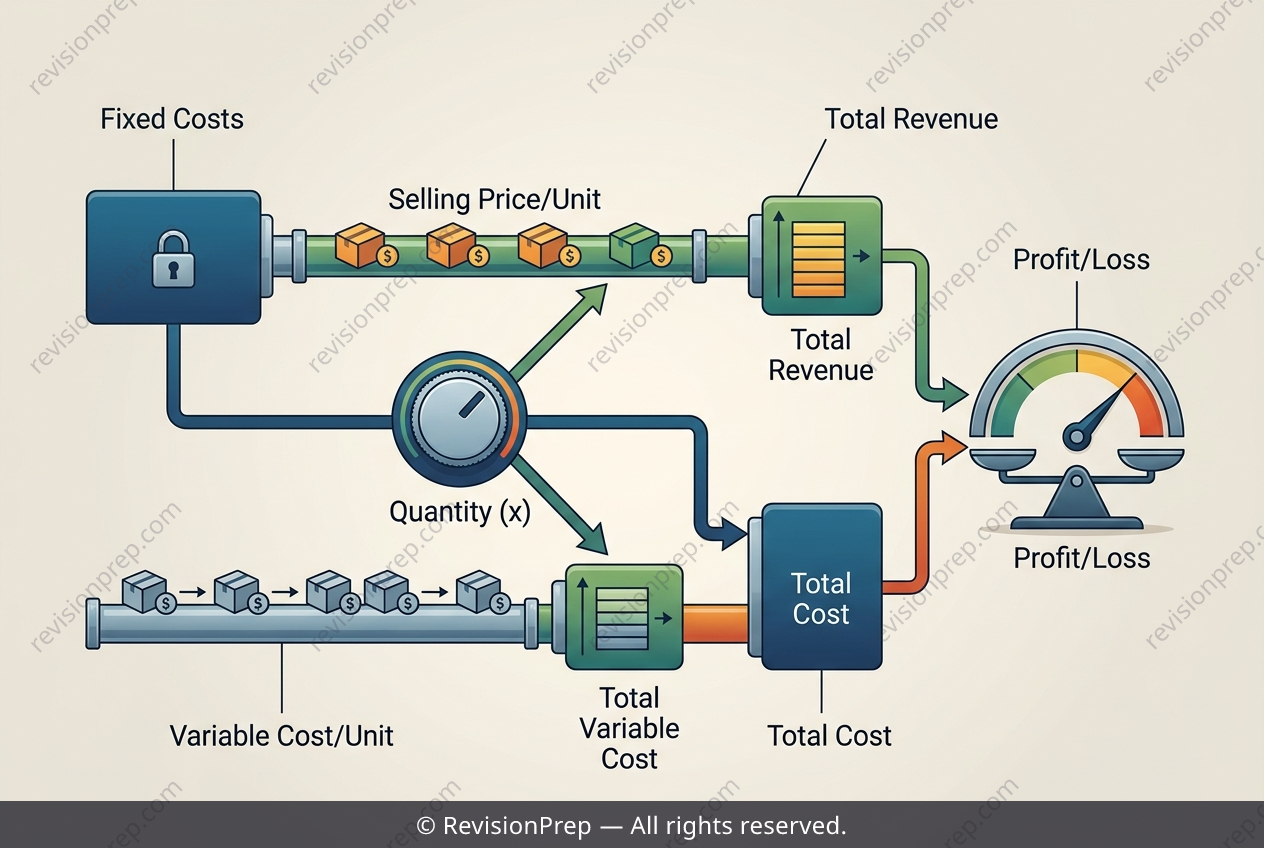
In the world of mathematics, variables and constants are the building blocks of any algebraic model. A variable, like x, represents a quantity that can change, while a constant is a fixed value that does not. When we combine them into a linear expression such as 50 + 2.5x, we create a powerful tool for describing real-world situations—here, the total cost of running a school bake sale. The constant, 50, anchors the model as the unavoidable venue rental fee, while the coefficient, 2.5, scales with each cookie produced, representing the variable cost per unit. This distinction is not just academic; it is the engine behind cost-revenue-profit analysis. By separating fixed costs from variable costs, we can build a profit function that reveals how earnings change with production. Revenue is simply the selling price multiplied by the number of units (4x), and profit emerges when we subtract the total cost from that revenue, yielding a new linear expression. Understanding how the constant shifts the baseline and how the coefficient tilts the slope allows you to predict outcomes, test scenarios, and make informed decisions—whether you are pricing cookies or planning a business.
Start practising IB questions today
150,000+ IB-styled questions, criteria-mapped and instantly accessible.