
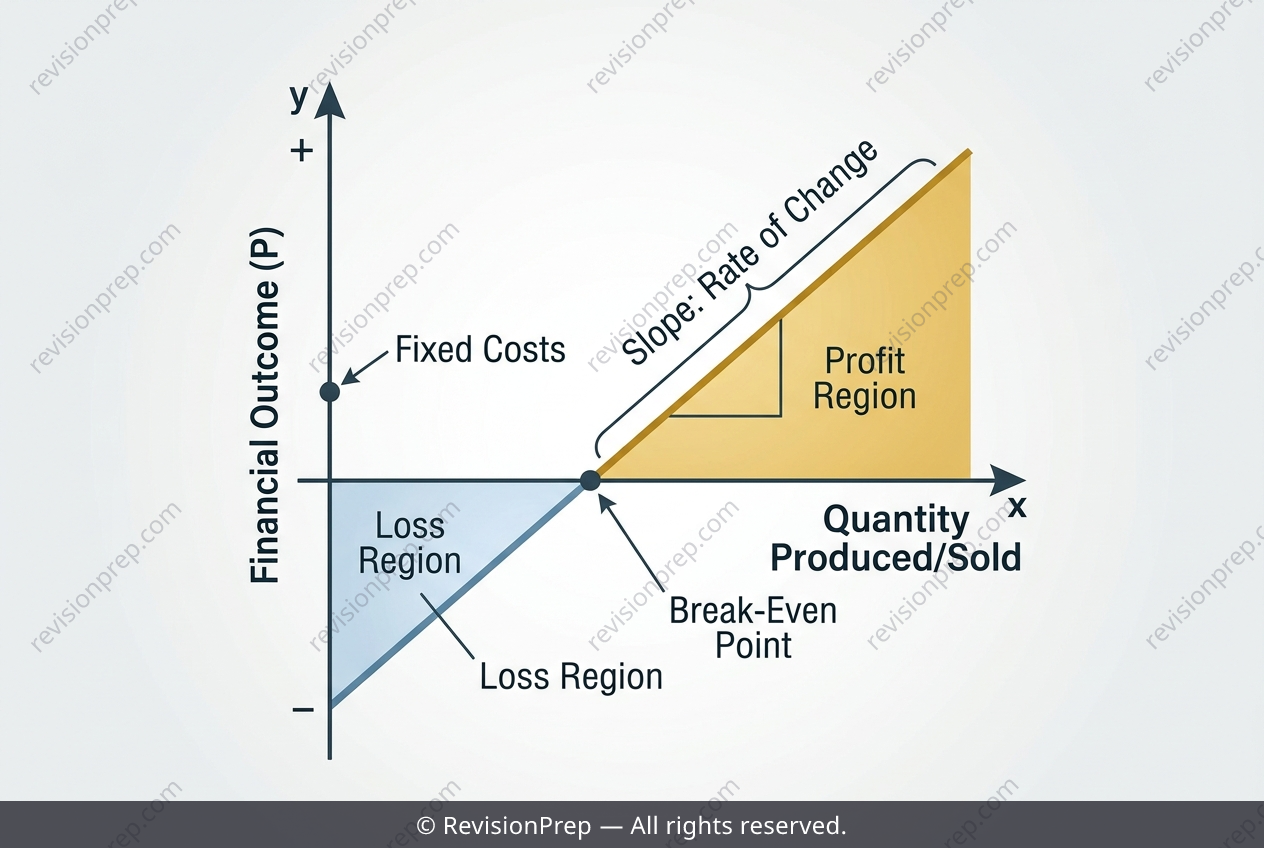
Maths: Linear Models: Writing and Interpreting Algebraic Expressions — Bake Sale Profit
Algebraic expressions are the language we use to turn real-world situations into something we can calculate with. In this case, a simple linear function like P(x) = 2.50x − 15 lets us model the profit from a school bake sale, where x is the number of cupcakes sold, 2.50 is the price per cupcake, and 15 is the fixed upfront cost. The beauty of this model is that it connects two key ideas: the rate of change (how profit grows with each sale) and the starting point (the loss you begin with before any sales). Understanding how to write and interpret such expressions matters because it reveals the hidden assumptions behind any mathematical model. For instance, plugging in a value for x gives you a profit or a loss, and a negative result isn’t just a number—it signals that costs exceed revenue, as when selling only a few cupcakes. But the model also simplifies reality: it assumes every cupcake baked is sold, and that the fixed cost never changes. These limitations remind us that a linear function is a useful snapshot, not a perfect mirror of the messy, variable world. By seeing how the parts—price, quantity, and fixed cost—interact, you learn to both trust and question the numbers you produce.
Start practising IB questions today
150,000+ IB-styled questions, criteria-mapped and instantly accessible.