
Maths: Linear Models: Writing and Interpreting Algebraic Expressions — Cookie Stand Profit
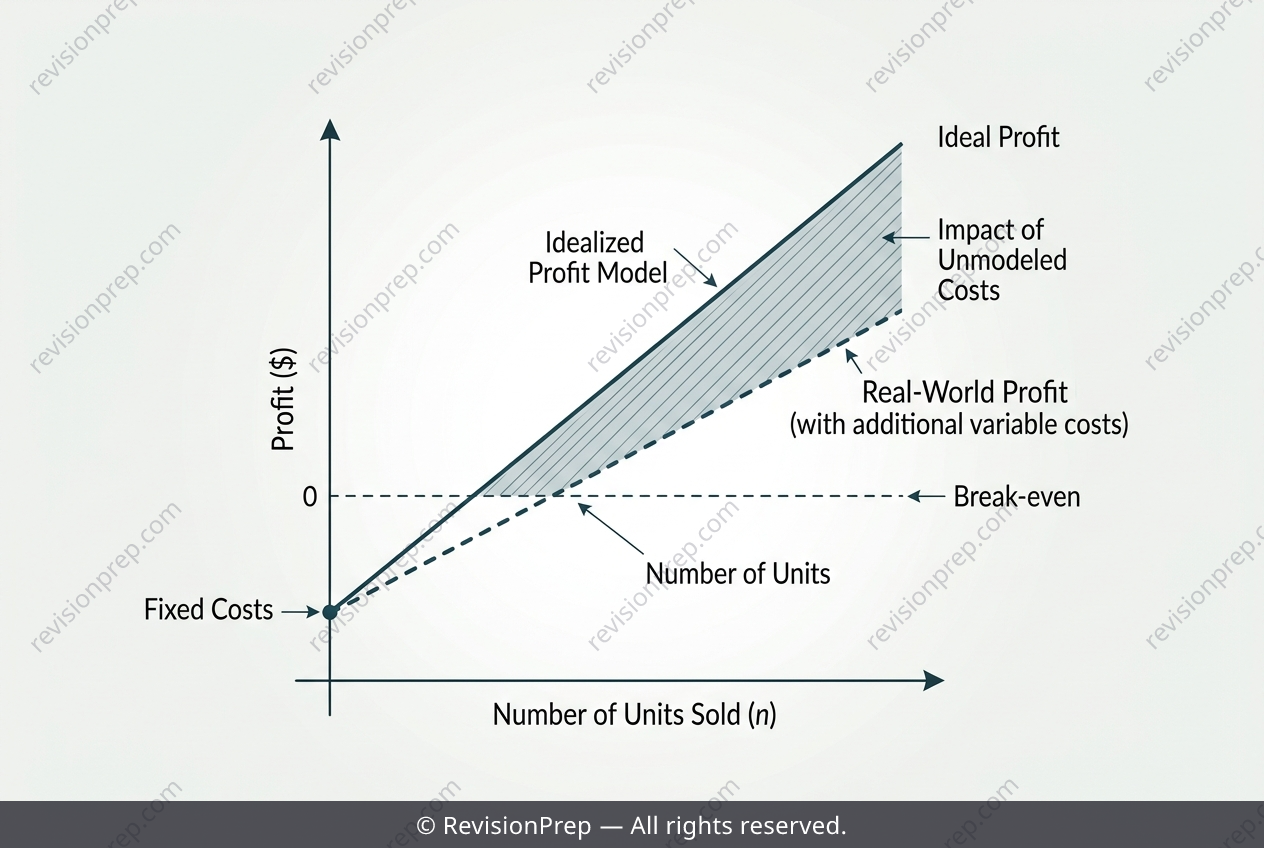
Algebraic expressions are the language we use to turn real-world situations into something we can calculate, predict, and question. In this case, a simple linear model like profit = 2n − 20 captures the relationship between the number of cookies sold (n) and the money left over after costs. The number 2 represents the price per cookie, while the −20 bundles together all fixed costs—ingredients and booth fee—that must be paid regardless of sales. This single expression lets us see at a glance how profit changes with each additional sale. What makes this model powerful is also what makes it fragile: every term carries an assumption. The fixed cost is subtracted upfront, meaning if no cookies are sold, the model predicts a loss equal to that total. But real life resists such clean arithmetic—if only two cookies are sold, the council wouldn’t have bought a full batch of ingredients, so the actual loss would be smaller. Likewise, the model assumes every cookie sells at the same price and ignores extra per-cookie costs like packaging. When those are added, the slope of the line changes, and the model’s predictions drift further from reality as sales grow. Understanding which parts of an expression are fixed, which are variable, and what they truly represent is the key to evaluating whether a model is useful—or just a neat formula.
Start practising IB questions today
150,000+ IB-styled questions, criteria-mapped and instantly accessible.