
Maths: Mastering Linear Programming: Maximizing Profit with Feasible Regions
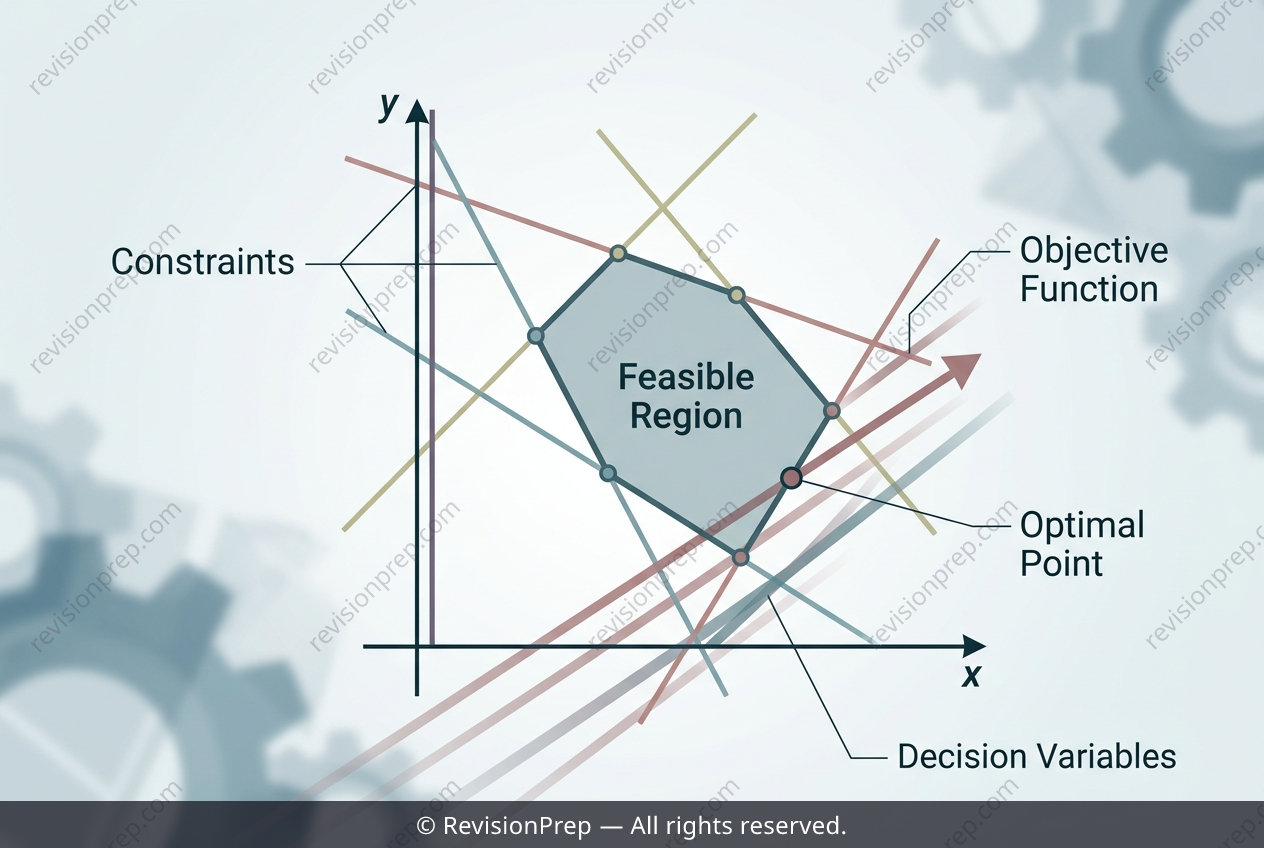
Linear programming is a method for finding the best possible outcome—like maximum profit or minimum cost—under a set of limiting conditions, called constraints. In this case, a factory produces standard and deluxe chairs, with production limited by inequalities such as x + y ≤ 8 and y ≤ x + 2, where x and y are non-negative integers. The feasible region is the set of all points (x, y) that satisfy every constraint simultaneously, and its shape is a polygon whose corners, or vertices, are crucial: the optimal value of a linear objective function, here P = 30x + 50y, always occurs at one of these vertices. Why does this matter? Real-world decisions—from manufacturing to logistics—rarely have unlimited resources. Linear programming gives a systematic way to allocate scarce inputs to maximize gain. The key relationships are geometric: each constraint is a straight line boundary, and the feasible region is their intersection. By finding the vertices (solving pairs of boundary equations) and then evaluating the profit formula at each vertex, you compare all candidate optima. The largest value of P reveals the best production mix. This also exposes common misconceptions—for instance, equal production (x = y) may seem intuitive, but the profit weights (30 vs. 50) and constraint slopes often make an unequal mix superior, as the vertex evaluation demonstrates.
Start practising IB questions today
150,000+ IB-styled questions, criteria-mapped and instantly accessible.