
Maths: Mathematical Modeling Limits in Real-World Transformations
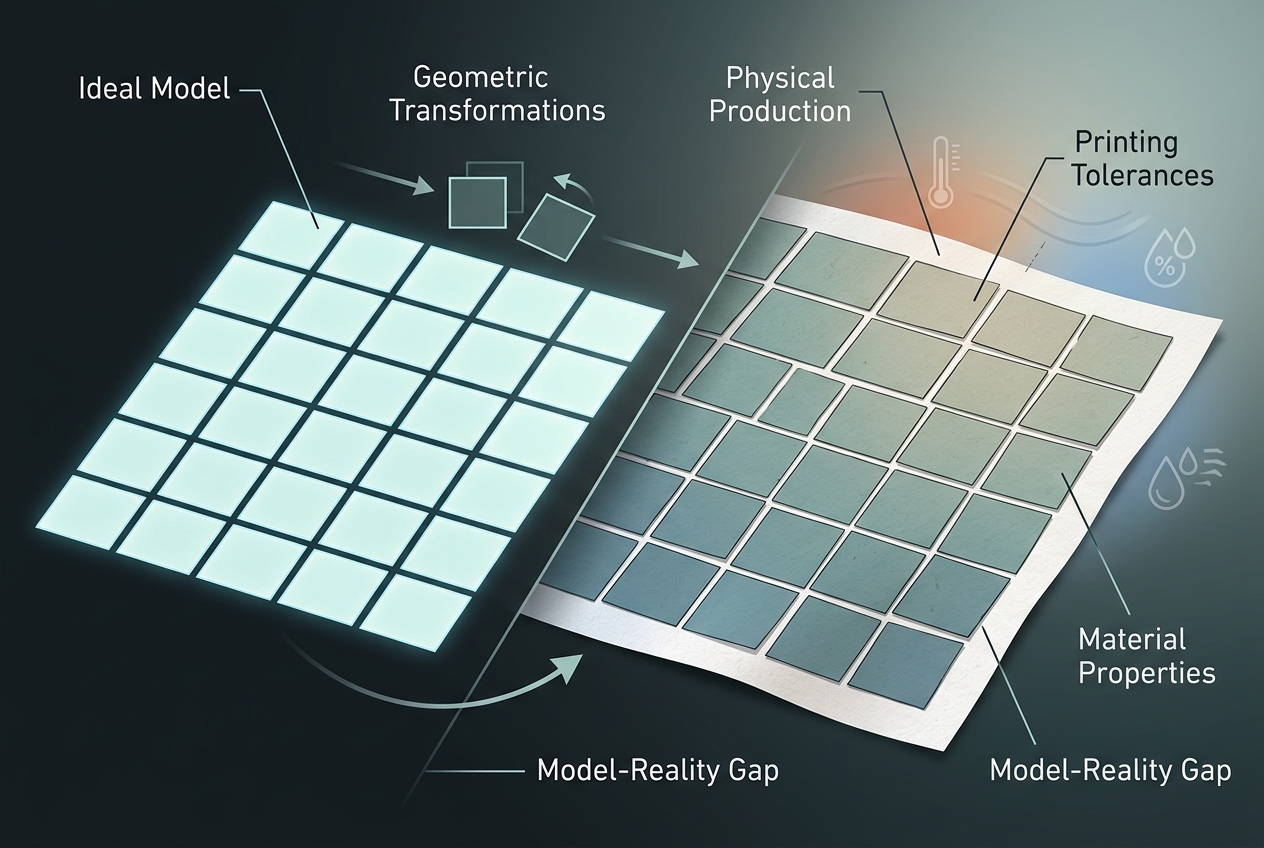
When a geometric shape undergoes multiple transformations—such as a translation followed by a rotation—the result is a combined transformation, a core concept in coordinate geometry that models how objects move and align in space. In this example, a unit square is first shifted horizontally by a vector (3,0), then rotated 90° counterclockwise about the point (3,0). The mathematical rule for this specific rotation, derived by temporarily shifting the centre to the origin, is (x, y) → (3 − y, x − 3). Applying these steps in order yields a final square that sits exactly adjacent to the original translated square, sharing a common edge without any gap or overlap. This seamless tiling prediction relies on two key assumptions: perfect numerical precision (coordinates are exact real numbers) and zero-thickness, perfectly straight edges that coincide with mathematical line segments. Understanding these assumptions matters because real-world physical applications—like printing a tiled logo on a billboard—introduce tolerances and material constraints. The model elegantly shows how transformations connect algebraically and geometrically, but it also highlights the limitations of pure mathematics when applied to physical production, where tiny errors accumulate and gaps appear.
Start practising IB questions today
150,000+ IB-styled questions, criteria-mapped and instantly accessible.