
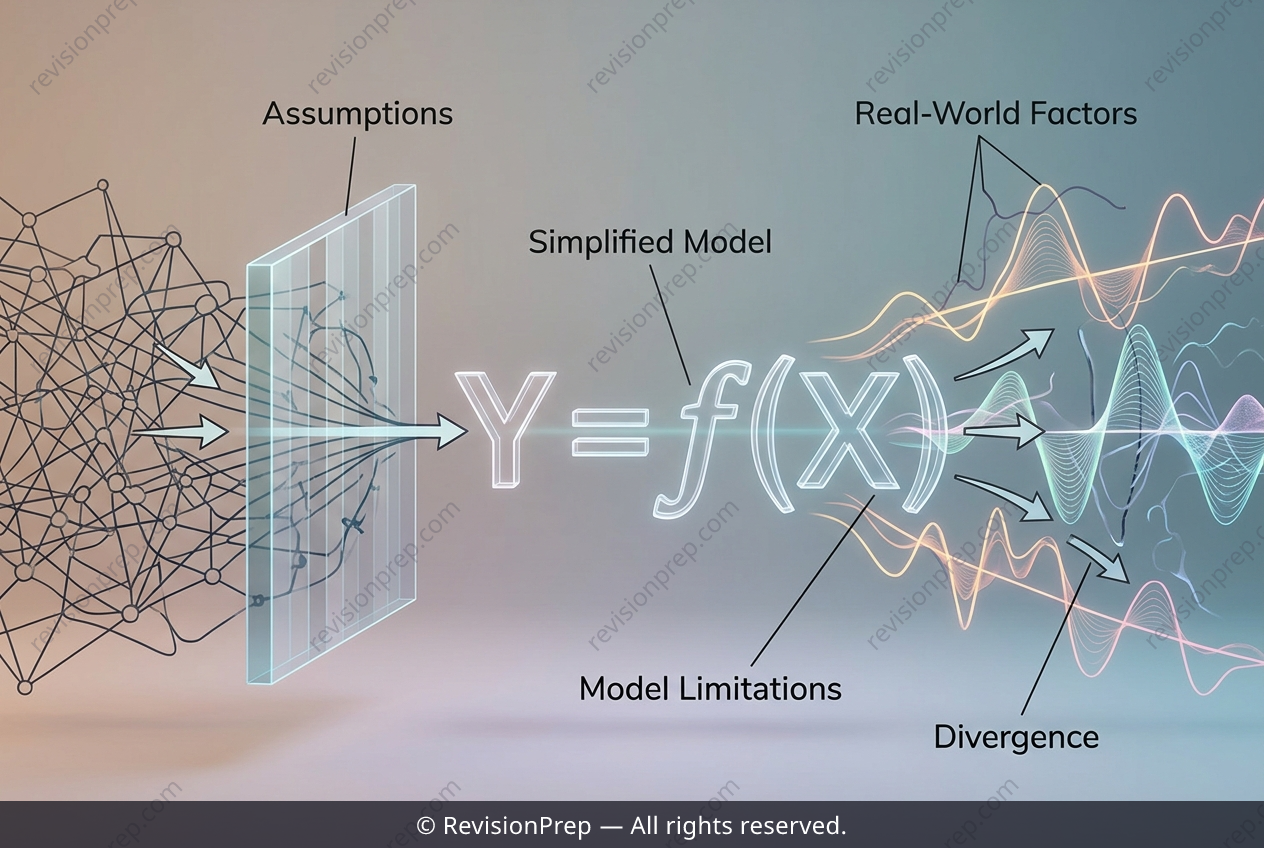
Maths: Mathematical Models: Assumptions and Limitations in IB Math
Mathematical modeling is the art of translating a real-world situation into a compact, symbolic form—like the expression 5n + 20, where n represents the number of cakes sold. At its heart, a model is a simplified story: it takes a messy reality and distills it into a few key variables and constants, making relationships visible and predictions possible. But that simplification comes at a cost. Every model rests on assumptions—here, that every cake made is sold, and that ingredient costs stay fixed at 20 dollars. These assumptions are not flaws; they are the model’s scaffolding, defining its boundaries. Understanding those boundaries is what separates a useful model from a misleading one. If unsold cakes pile up, the true revenue falls below 5n, so the model overestimates profit. If ingredient prices shift, the constant 20 becomes a moving target, skewing results in either direction. And real life always adds more—packaging, labor, or spoilage—each requiring a new term, such as subtracting a packaging cost p to get 5n − 20 − p. The power of modeling lies not in getting the “right” answer, but in knowing exactly what the model can and cannot see, and how each added variable sharpens or complicates the picture.
Start practising IB questions today
150,000+ IB-styled questions, criteria-mapped and instantly accessible.