
Maths: Mathematical Models: Variables, Constants, and Real-World Limits
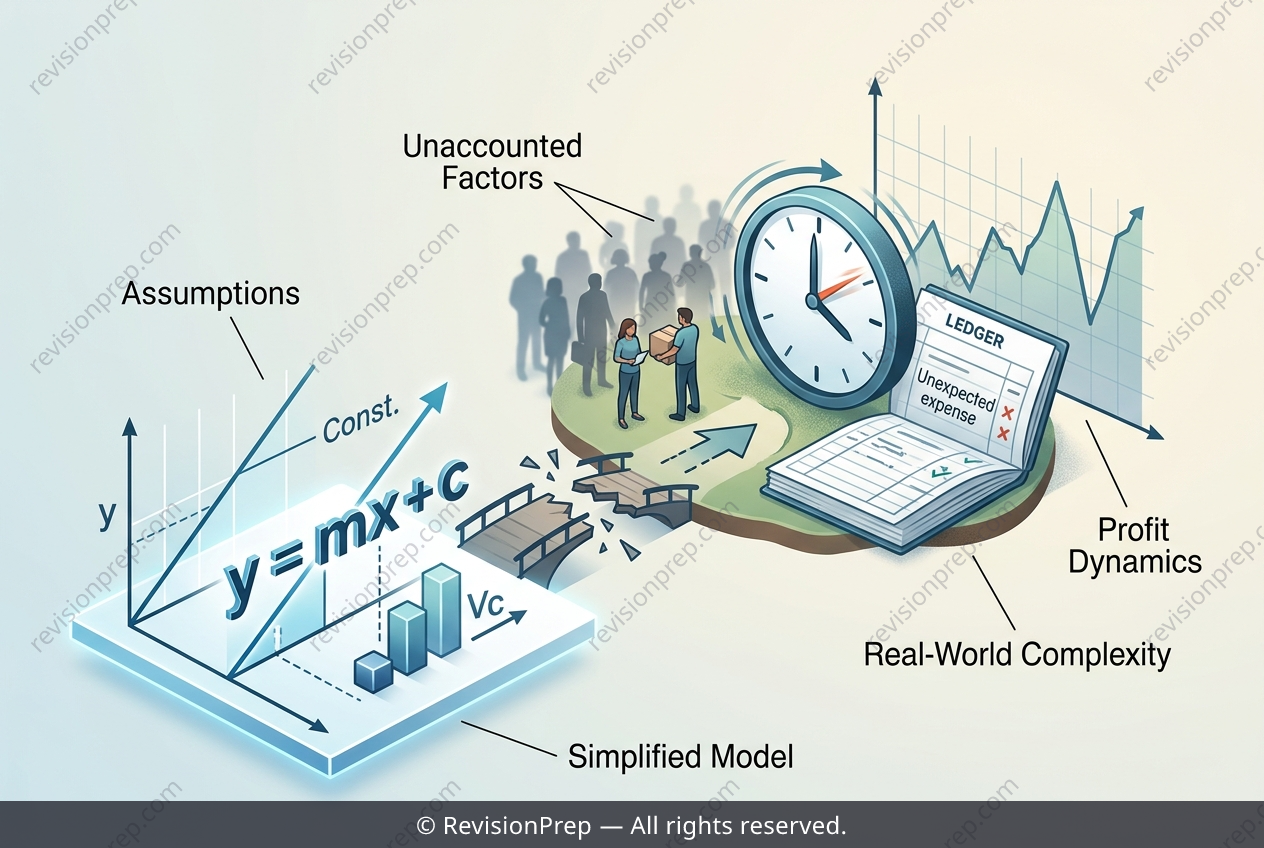
When a real-world situation is translated into mathematics, we often strip away its messiness to reveal a clean, predictable structure. In this case, a student selling handmade bracelets can model their business with simple linear expressions: if b bracelets are made, the cost is C = 5b + 12 (materials plus a fixed stall fee), and the revenue is R = 8b. From these, profit emerges as P = R − C, which simplifies to P = 3b − 12. This tidy formula suggests that every bracelet adds a constant 3 to profit, after covering the12 stall fee. But this is precisely where the concept of limitations of mathematical models becomes vital. The expression P = 3b − 12 assumes that costs and revenue are fixed and perfectly predictable—that every bracelet produced is sold, and that the only costs are materials and the stall fee. In reality, the model ignores factors like the economic value of the student’s own labor (time spent making bracelets) and the possibility of unsold inventory. Each of these would reduce actual profit below the model’s prediction. Understanding these gaps helps you see that a formula is not the truth, but a simplified lens—useful for quick estimates, yet always incomplete when applied to a living business.
Start practising IB questions today
150,000+ IB-styled questions, criteria-mapped and instantly accessible.