
Maths: Model to Reality: The Power of Scale Factors
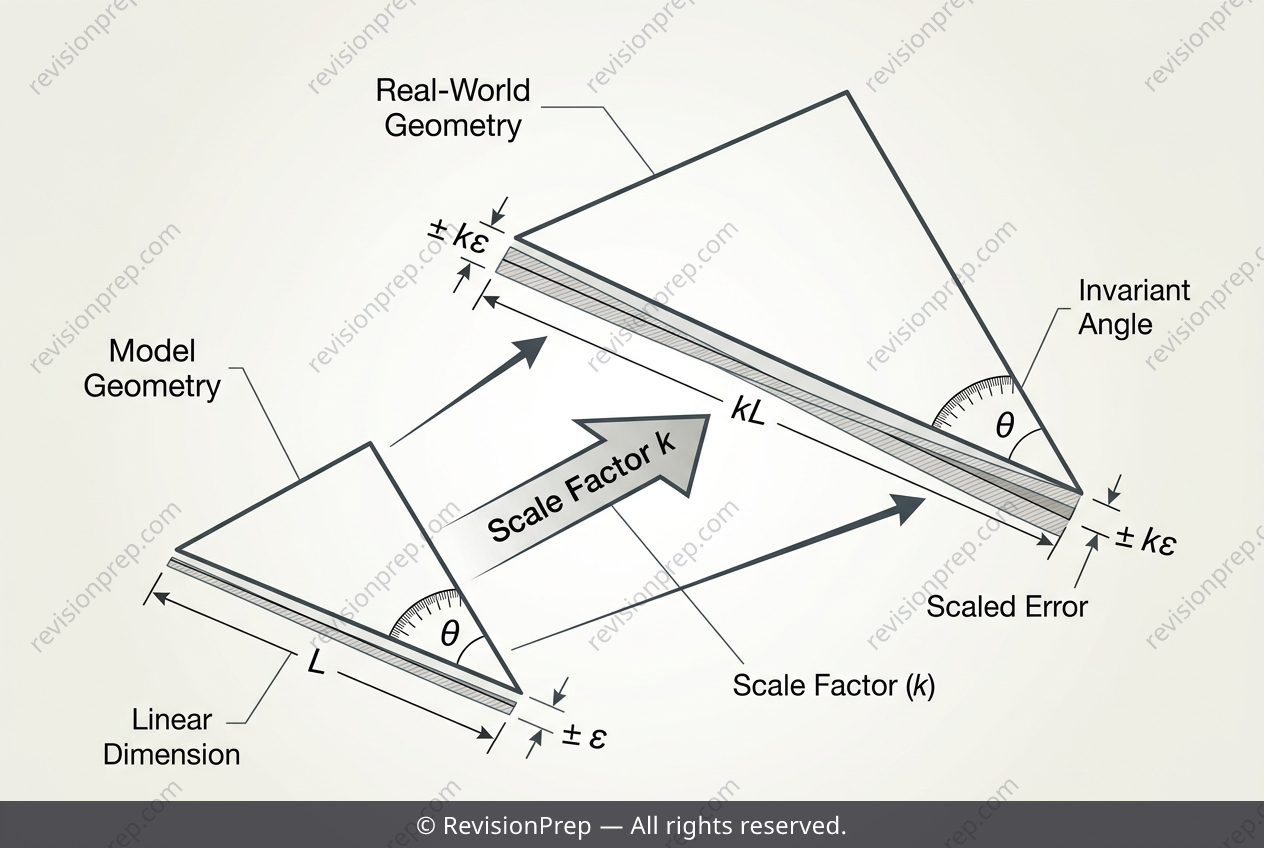
When an architect shrinks a house to 1:25 scale, the model is far more than a miniature decoration—it is a working tool for testing geometry before construction begins. The core concept here is geometric similarity: two shapes are similar when one is an exact enlargement or reduction of the other, meaning every length is multiplied by the same scale factor, while every angle remains untouched. This single idea links the model to the real building through a simple relationship: real distance = model distance × scale factor. Because the scale factor multiplies all linear dimensions, a 4.0 cm horizontal gap on the model becomes a far larger real-world span—but the 30° tilt of the solar panels does not change at all. Why does this matter? Because similarity lets us predict real-world sizes and positions without building full-scale first, yet it also exposes the limits of small models. While angles are preserved perfectly, measurement errors on the model are also scaled up—a tiny ±0.5 mm uncertainty becomes a much larger real-world error when multiplied by 25. This reveals the delicate balance between the power of scale transformations and the reliability of the data they produce. Understanding how lengths scale, angles stay fixed, and errors amplify is essential for turning a model’s geometry into trustworthy, real-world decisions.
Start practising IB questions today
150,000+ IB-styled questions, criteria-mapped and instantly accessible.