
Maths: Modeling Real-World Costs: Substitution and Formula Limits
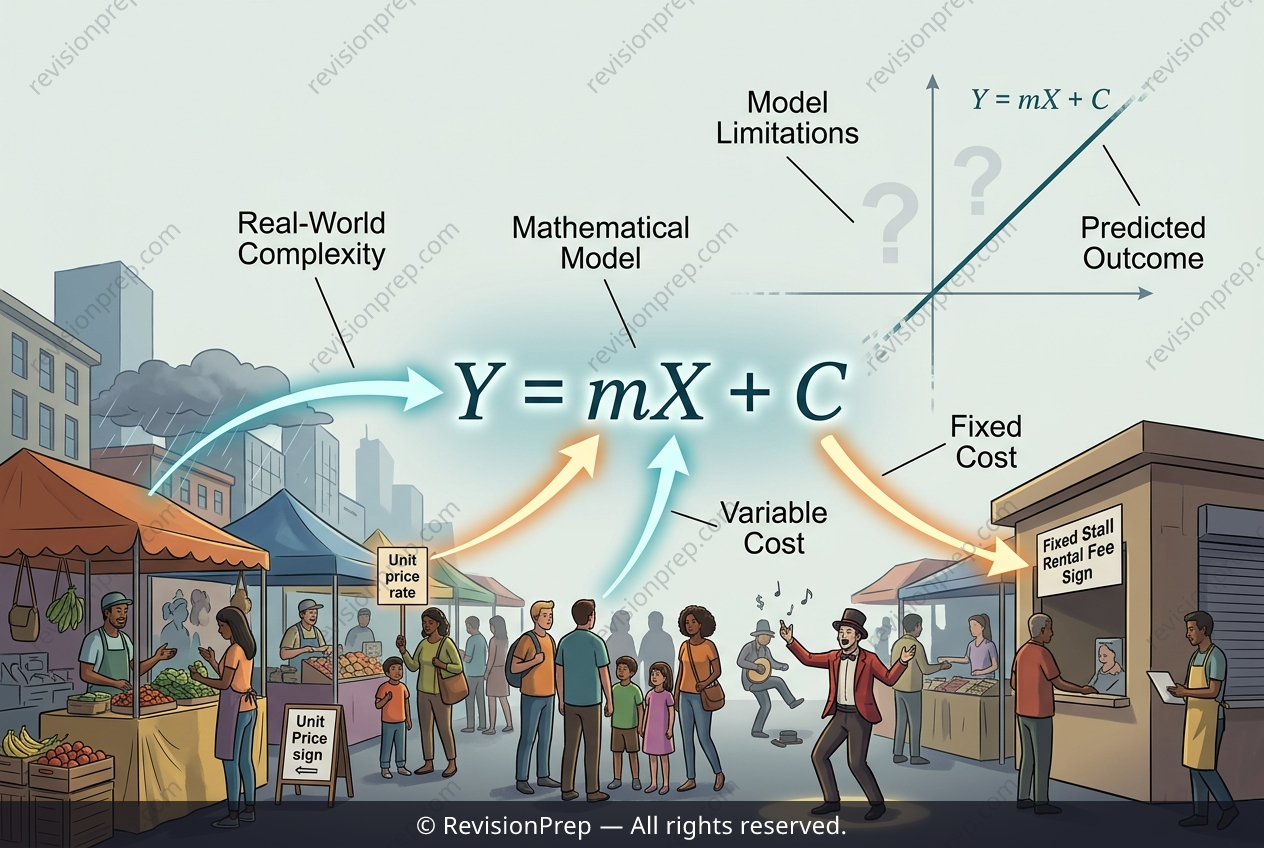
Substitution into expressions and formulae is the mathematical engine behind turning real-world situations into numbers you can actually use. At its heart, it’s about taking a rule—like Total Cost = 15 × n + 50—and plugging in a value for n to see what happens. But the real power lies in what that rule represents: the 15 × n part is a variable cost that scales with the number of students (think entrance fees or lunch per head), while the 50 is a fixed cost that stays the same no matter what (like hiring a bus or booking a venue). Together, they model a school trip’s total expense. Why does this matter? Because every formula is a simplified story about the world, and substitution lets you test that story. The model works beautifully when assumptions hold—every student pays the same fee, everyone attends. But reality is messier: discounts, absentees, or unexpected charges break the neat linear relationship. Understanding how the parts connect—variable versus fixed, input versus output—helps you see not just what the formula predicts, but where it might fail. That gap between the clean equation and the messy world is the heart of mathematical modeling.
Start practising IB questions today
150,000+ IB-styled questions, criteria-mapped and instantly accessible.