
Maths: Perpendicular Gradients and Uncertainty in IB Math
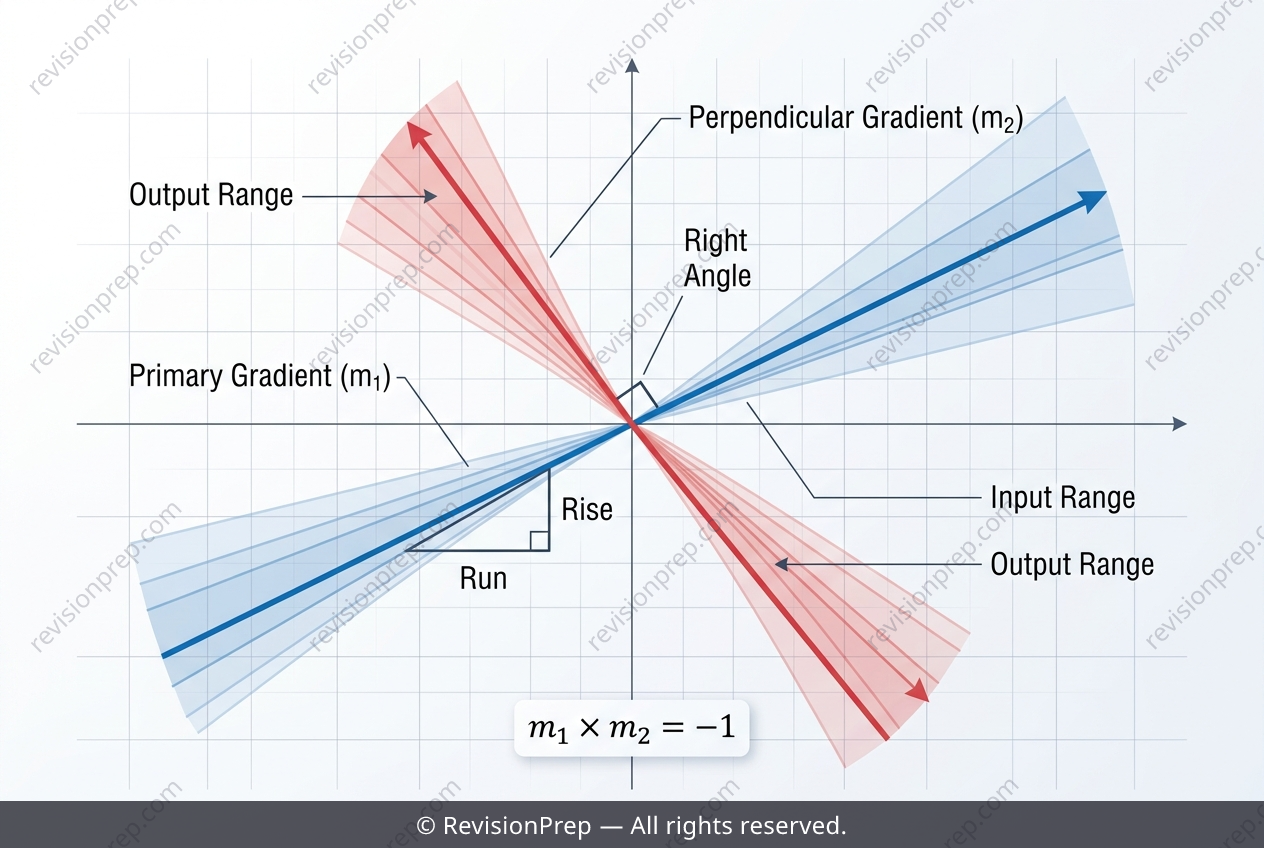
When a road rises 3 metres for every 100 metres of horizontal distance, its gradient is 3% — but what happens when you need to install a drainage pipe that must run perfectly perpendicular to that slope? This is where the relationship m₁ × m₂ = -1 comes into play: if two lines are perpendicular, their gradients are negative reciprocals of each other. For a given road gradient m₁, the pipe’s slope m₂ is simply -1 divided by m₁, a direct application of this rule. The real-world twist arrives with measurement uncertainty. Survey instruments rarely give exact values; a stated 3% gradient might actually lie anywhere between 2.5% and 3.5%. Because the perpendicular slope is a reciprocal function, this small uncertainty in m₁ does not translate symmetrically — the lower bound of the road gradient produces a much steeper pipe slope than the upper bound does. This asymmetry matters for engineering: a pipe designed for the “average” slope may fail to drain properly if the true gradient sits at either extreme. Understanding how uncertainty propagates through the perpendicular-gradient formula is therefore not just a mathematical exercise — it is the difference between a drainage system that works and one that floods.
Start practising IB questions today
150,000+ IB-styled questions, criteria-mapped and instantly accessible.