
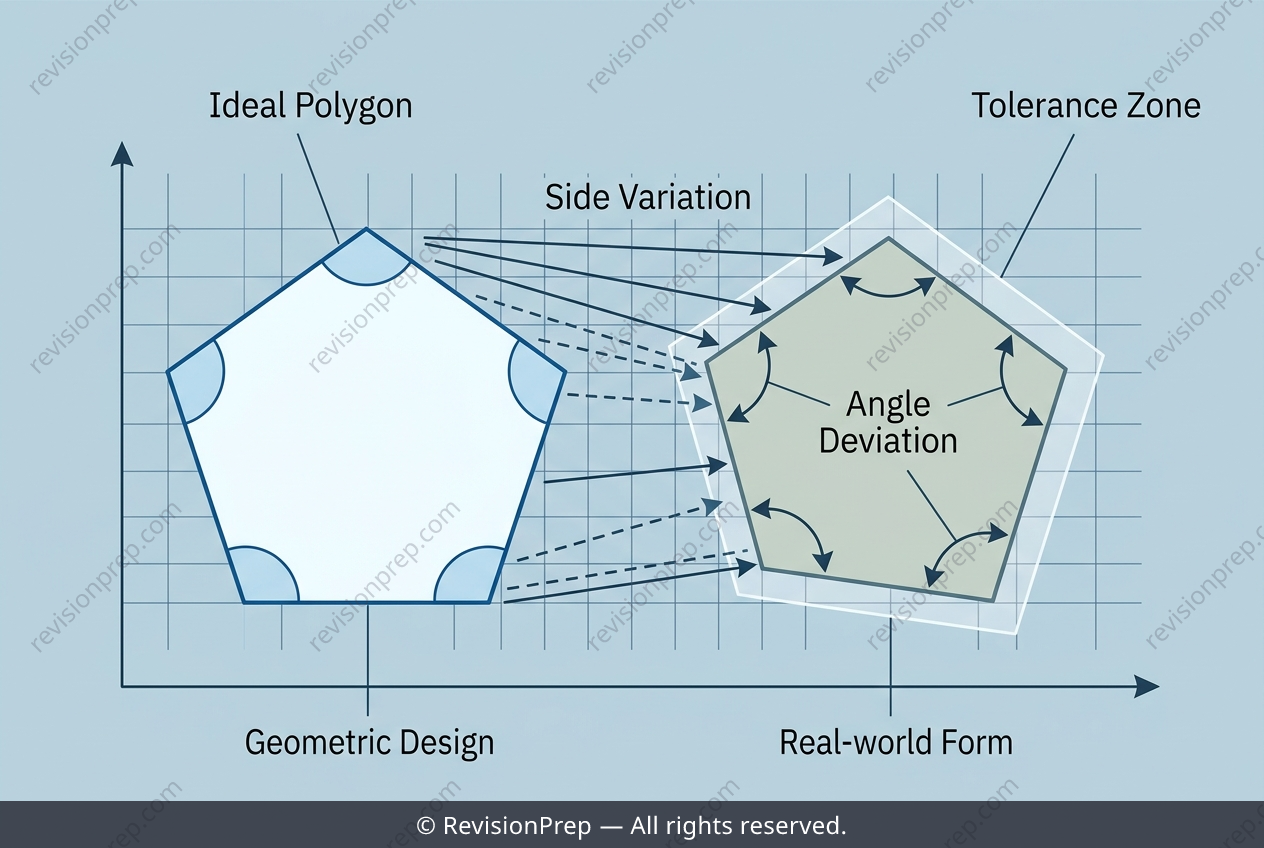
Maths: Polygon Angles & Geometric Tolerance
Geometry is often taught as a set of fixed rules, but real-world objects—like a pentagonal window—rarely match perfect mathematical ideals. This topic explores the tension between the clean formulas of regular polygons and the messy reality of manufacturing, where every side length carries a small margin of error. At the heart of this is the interior angle formula for a regular n-sided polygon: (n − 2) × 180° / n. For a pentagon, this yields a single, elegant value, but that value assumes all sides are exactly equal. The moment side lengths vary—even by a few centimetres—the polygon becomes irregular. Its interior angles shift: some grow larger, others smaller, and the neat formula no longer predicts them. Yet one relationship holds firm: the sum of interior angles for any pentagon is always 540°. This invariant lets you calculate a missing angle when others are known, and then compare it against a tolerance range. Understanding how variability breaks regularity while preserving the total sum is key to judging whether a manufactured shape is acceptable—a concept that bridges pure geometry with practical engineering limits.
Start practising IB questions today
150,000+ IB-styled questions, criteria-mapped and instantly accessible.