
Maths: Proportional Scaling: Constants, Coefficients, and Ratios
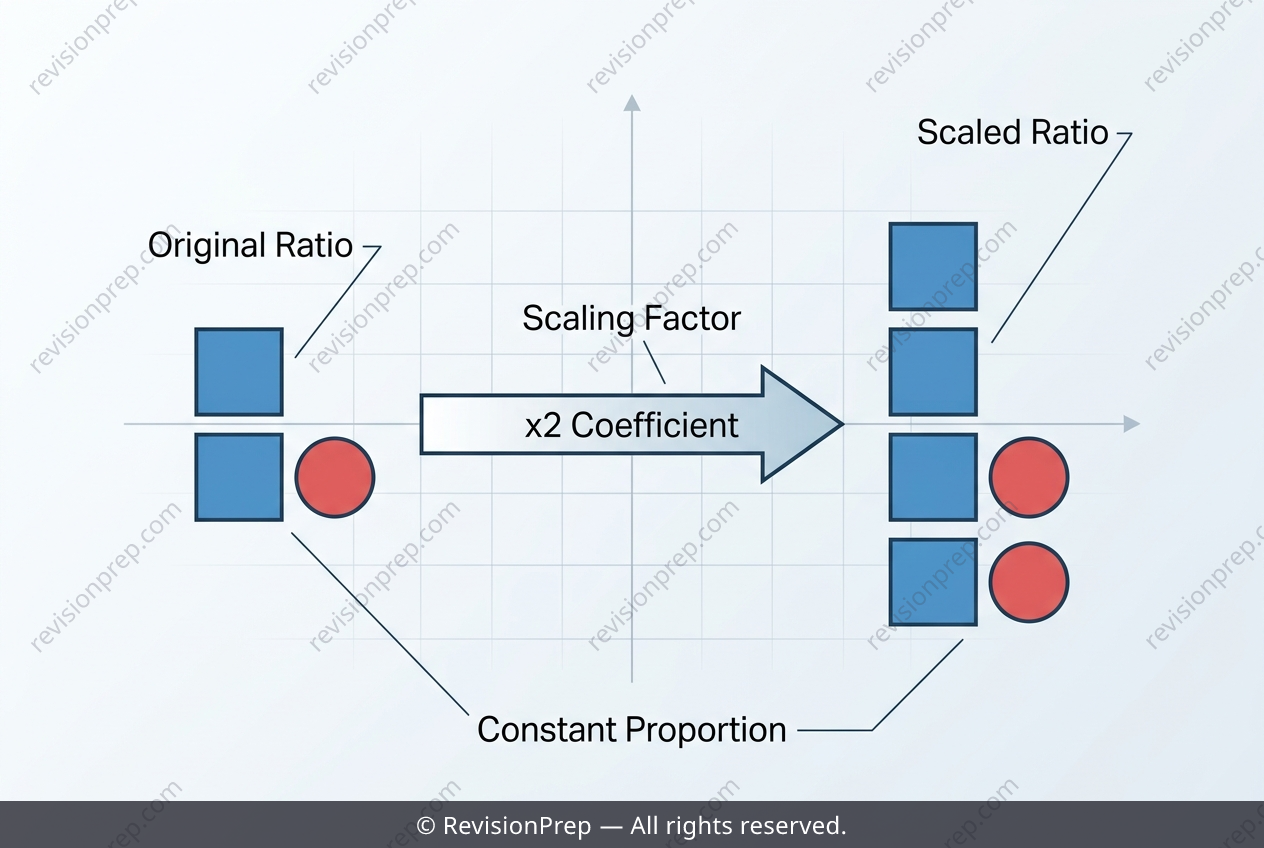
When you scale a recipe from four servings to eight, you’re not just doubling ingredients—you’re applying one of the most fundamental ideas in algebra: the relationship between constants, coefficients, and proportional reasoning. At its heart, this topic asks you to separate what stays fixed (the per-person amount) from what changes (the total quantity), and to see how a single multiplier connects them. The key insight is that the amount of flour and sugar needed for one person is a constant—it never varies, no matter how many people you serve. That constant (0.5 cups of flour per person, 0.25 cups of sugar per person) is then multiplied by a coefficient, which in this case is the number of servings (8). This coefficient acts as a scaling factor, stretching the original per-unit values into new totals. Crucially, the ratio between the two constants must remain unchanged: if the original recipe has a 2:1 flour-to-sugar ratio, then doubling both ingredients preserves that ratio, keeping the dish’s texture and taste identical. Understanding this distinction—between the unchanging per-unit constant and the variable coefficient that scales it—is what turns a simple cooking problem into a powerful model for any proportional relationship, from physics formulas to financial calculations.
Start practising IB questions today
150,000+ IB-styled questions, criteria-mapped and instantly accessible.