
Maths: Proving the Triangle Angle Sum with Invariance
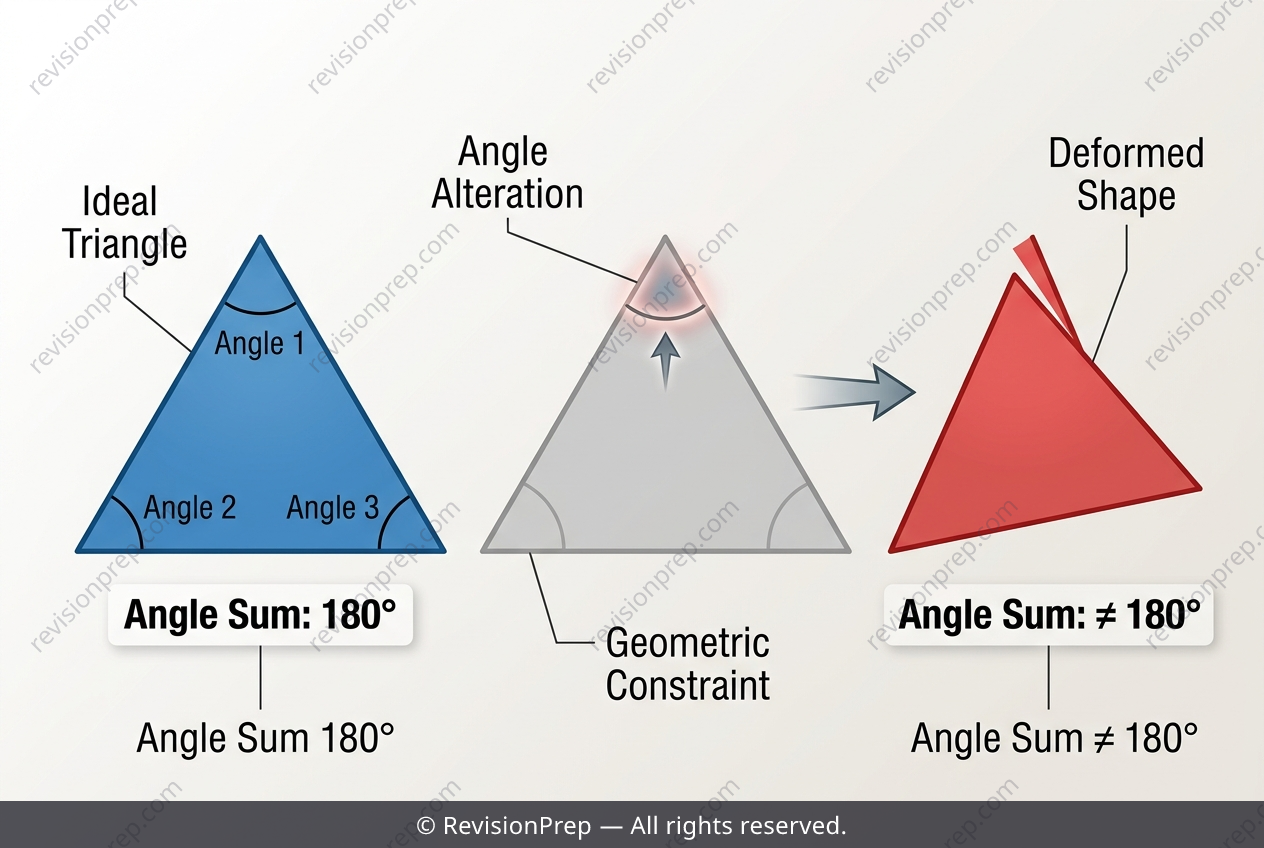
Triangles are the quiet backbone of geometry, but their most powerful secret is invariance: no matter how you stretch or shrink a triangle, the sum of its interior angles remains locked at 180°. This angle sum property is not just a neat fact—it is the structural guarantee that lets engineers, architects, and designers model real-world objects like roof trusses with confidence. When you express a triangle’s angles as algebraic expressions, such as (2x + 10)°, (3x − 5)°, and (x + 15)°, you are essentially writing a constraint equation: those three expressions must add to 180°. Solving that equation reveals the single value of x that makes the triangle “work” geometrically. The deeper insight lies in what happens when that invariant is broken. If you nudge one angle by even 2°, the sum drifts to 182°—a number that defies Euclidean geometry. The sides can no longer close into a triangle, and the model collapses into an impossible shape. This connection between algebraic solving and geometric feasibility is the heart of the topic: the angle sum property isn’t just a rule to memorize; it’s a diagnostic tool that tells you whether a set of angles can ever form a real, closed triangle. Understanding this relationship turns a simple formula into a lens for verifying the integrity of any triangular design.
Start practising IB questions today
150,000+ IB-styled questions, criteria-mapped and instantly accessible.