
Maths: Quadratic Functions: Vertex, Axis of Symmetry, and Real-World Shots
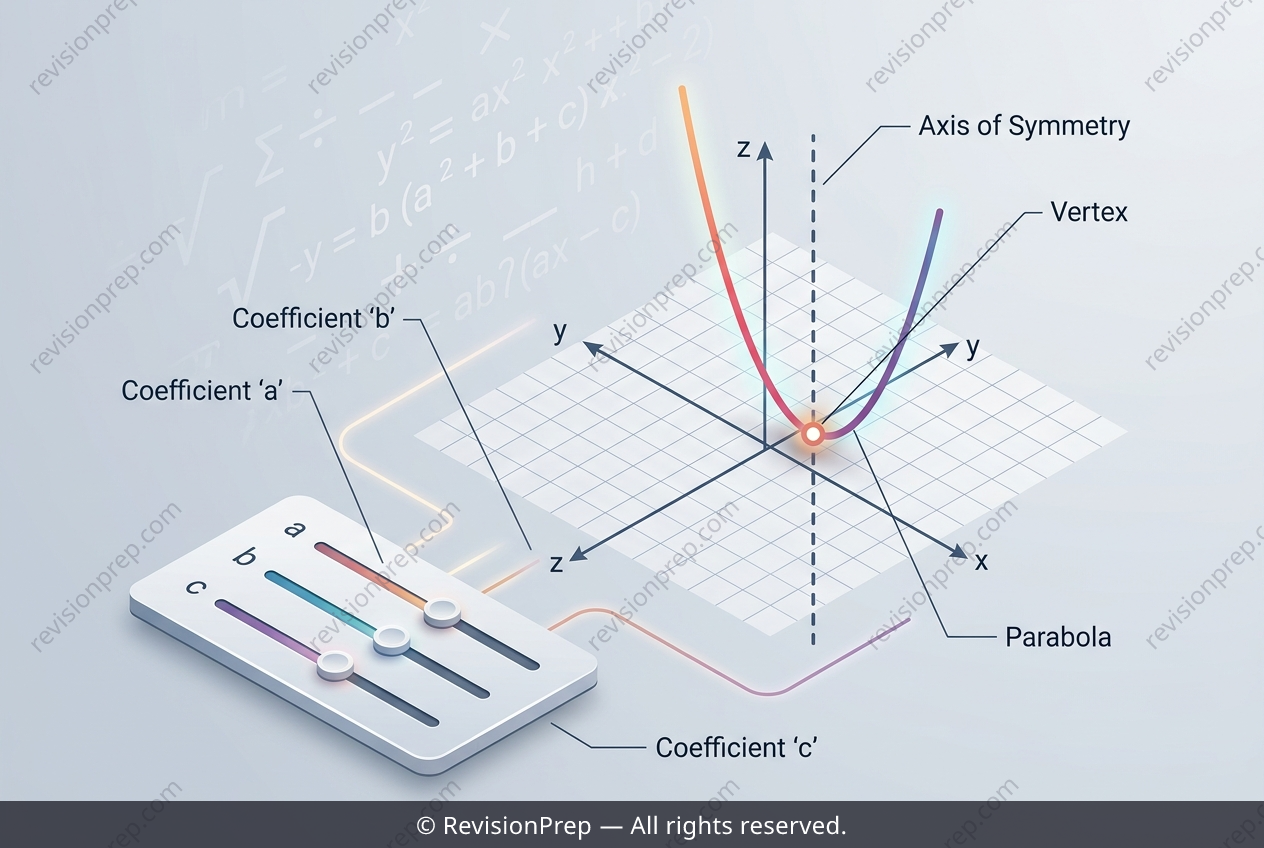
Quadratic functions are the mathematical backbone of parabolic motion, and in this case, they model the arc of a basketball shot. At its core, this topic asks you to translate a simple algebraic expression into a visual curve, then extract meaningful features like symmetry and maximum height. The key relationship here is the axis of symmetry, found using the formula x = -b/(2a), which acts as the vertical mirror line for the parabola. Once you locate this line, you can substitute that x-value back into the original function to find the vertex—the highest or lowest point of the curve. For a downward-opening parabola (where a is negative), this vertex represents the peak of the shot. What makes this concept powerful is how these parts connect: the axis of symmetry isn’t just a geometric curiosity—it directly gives you the x-coordinate of the vertex, and that vertex tells you the maximum height the ball reaches. Then, by evaluating the function at any other horizontal distance, you can check whether the ball meets a specific target, like a hoop at a certain height. This single function thus ties together symmetry, optimisation, and real-world prediction, showing how a few algebraic steps can answer practical questions about motion and precision.
Start practising IB questions today
150,000+ IB-styled questions, criteria-mapped and instantly accessible.