
Maths: Quadratic Optimization: Maximizing Area with 100m of Fencing
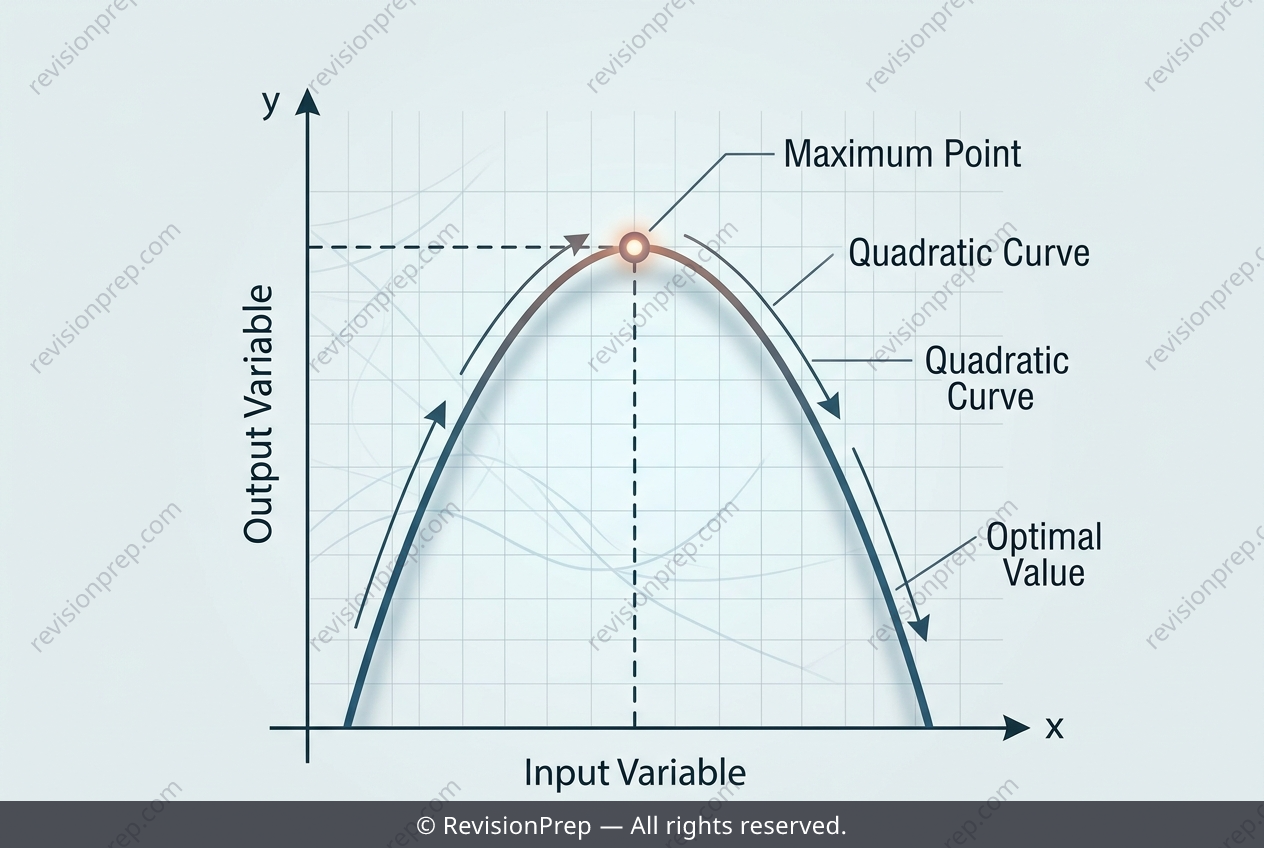
Quadratic functions are everywhere in optimization problems, and this classic fencing scenario is the perfect way to see them in action. When a farmer has a fixed length of fencing, the area of a rectangular enclosure isn’t fixed—it changes with the chosen side length. By modelling the area as A = l(50 - l), you’re really expressing a relationship where one variable (length) determines the outcome (area), and the shape of that relationship is a parabola. Expanding this into standard quadratic form, A = -l² + 50l, reveals the key feature: the negative coefficient on l² tells you the parabola opens downward, meaning there is a single highest point—a maximum area. That maximum isn’t random; it occurs exactly at the midpoint of the two roots of the equation, where the parabola is symmetric. Here, the roots are l = 0 and l = 50, so the peak sits at l = 25. Substituting this value back into the expression gives the largest possible area, which is what the farmer claims. Understanding this connection—between the algebraic form, the geometric symmetry, and the real-world meaning of “maximum”—is the core of quadratic optimization. It’s not just about plugging numbers in; it’s about seeing how the structure of the equation dictates the best possible outcome.
Start practising IB questions today
150,000+ IB-styled questions, criteria-mapped and instantly accessible.