
Maths: Quadrilateral Angles & Measurement Error
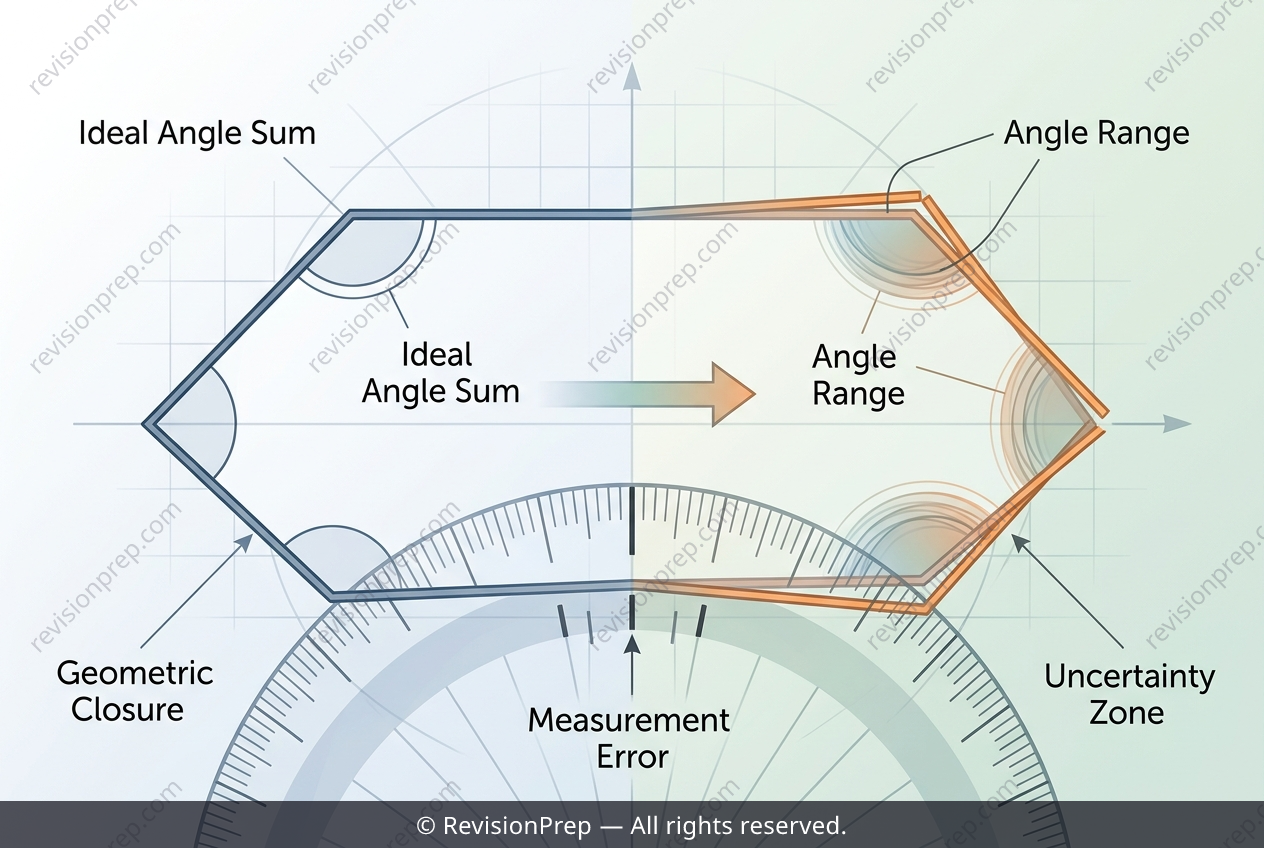
A single glance at a quadrilateral’s four interior angles might seem like a simple check, but the real mathematical story begins when those numbers are not perfectly reliable. At its heart, this topic explores how measurement error—the tiny, unavoidable imprecision in any tool—can transform a seemingly straightforward geometric proof into a question of certainty versus probability. The core rule here is elegant: for any four-sided shape to close without gaps or overlaps, its interior angles must sum to exactly 360°. This is not a suggestion but a rigid condition of Euclidean geometry, and it forms the backbone of everything from tiling patterns to structural design. Yet the power of this rule lies in how it interacts with real-world data. When a designer records angles like 95°, 85°, 90°, and 90°, the sum appears to satisfy the 360° condition perfectly. However, each measurement carries a potential error of ±2°, meaning the true value of each angle could be slightly higher or lower. The critical insight is that these errors compound: the total possible deviation across all four angles is not just 2°, but the sum of individual uncertainties. This forces us to consider a range of possible true sums—from a minimum to a maximum—rather than a single fixed number. Only by comparing that entire range against the required 360° can we judge whether the quadrilateral will truly close, revealing how a simple angle rule becomes a powerful tool for assessing reliability in practical construction.
Start practising IB questions today
150,000+ IB-styled questions, criteria-mapped and instantly accessible.