
Maths: Substitution in Real-World Models: Why Assumptions Change Your Answer
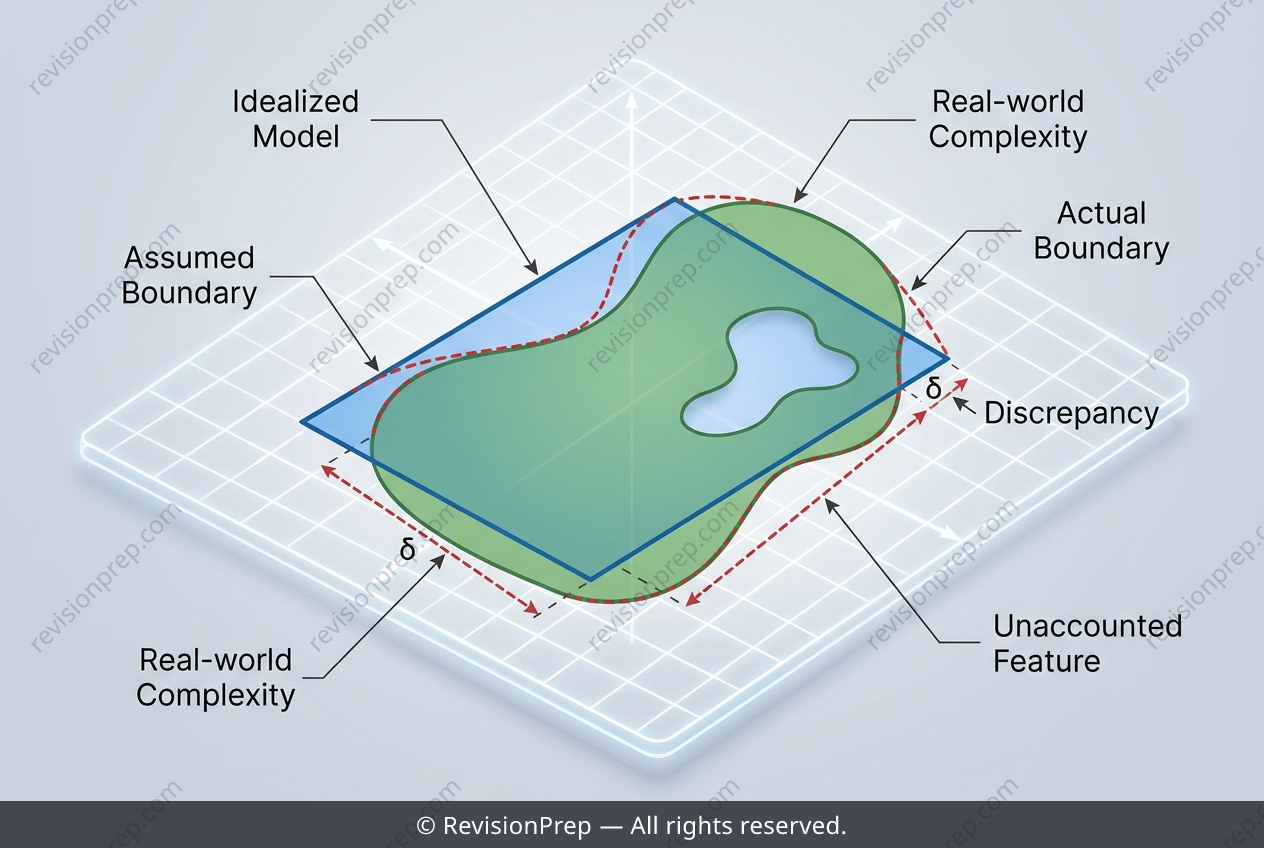
Substitution into expressions and formulae is the mathematical engine behind almost every real-world estimation, from engineering blueprints to budget forecasts. At its core, it is a simple act: you take a known relationship—like the perimeter formula P = 2(l + w)—and feed it specific values to produce a single, usable number. But the real skill lies not in the arithmetic, but in understanding what that number actually represents. The power of a formula is also its weakness. Every formula is built on assumptions—in this case, that the park is a perfect rectangle with four straight sides. When reality deviates, as it does with a curved boundary or an internal pond, the substitution still yields a clean result, but that result becomes an approximation, not a truth. The formula’s precision is an illusion of simplicity. Recognising this gap between the mathematical model and the physical world is what separates a mechanical calculation from a critical evaluation. It forces you to ask: what has been left out, and how does that omission skew the estimate—towards underestimation or overestimation? This awareness is the foundation of responsible modelling.
Start practising IB questions today
150,000+ IB-styled questions, criteria-mapped and instantly accessible.