
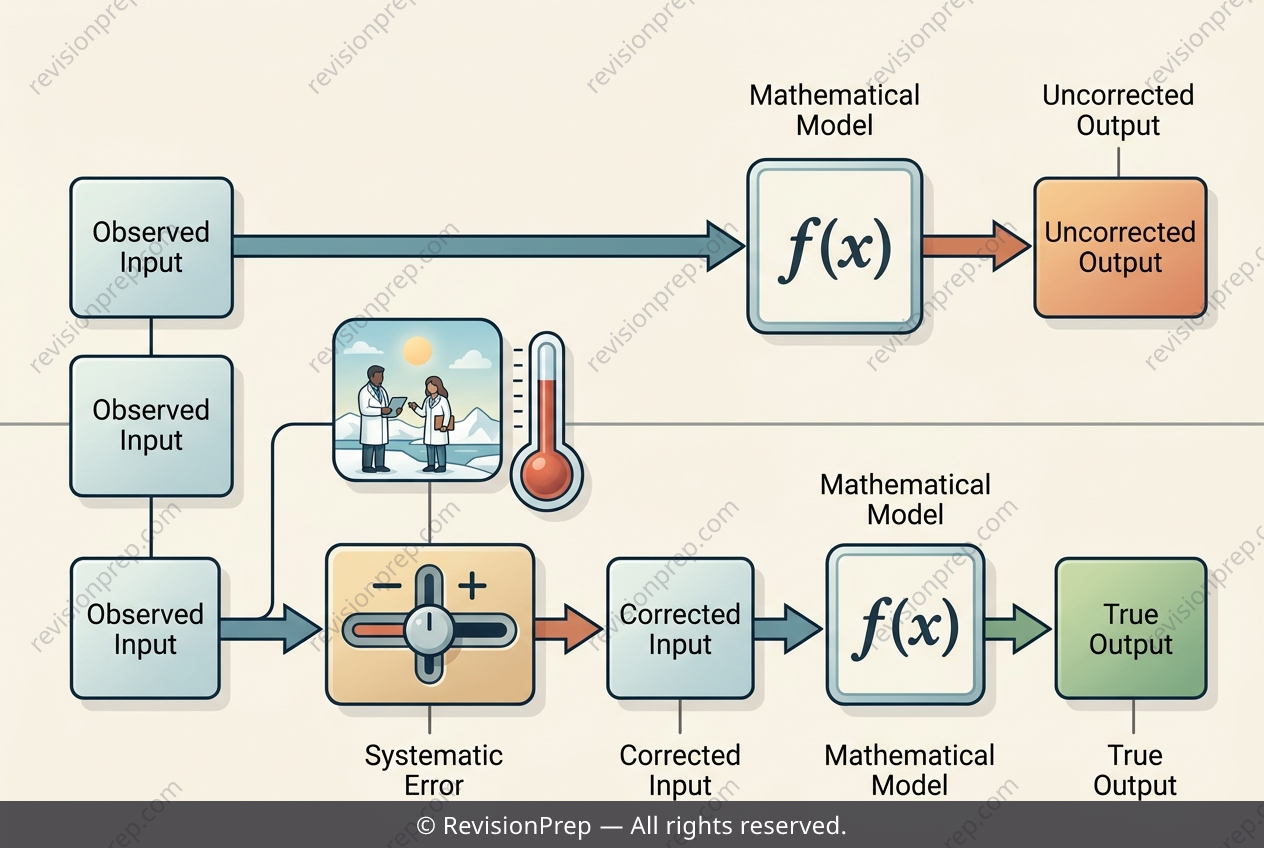
Maths Systematic Error in Formula Substitution: Celsius to Fahrenheit
When a scientist converts a temperature reading from Celsius to Fahrenheit, they are performing a substitution into a formula—a seemingly simple act of arithmetic. Yet beneath that calculation lies a deeper mathematical idea: how a fixed error in one variable propagates through a linear relationship, and whether the result we trust is actually reliable. In this case, the formula F = 1.8C + 32 maps every Celsius value to a unique Fahrenheit value, but the thermometer’s systematic offset of −2°C means the recorded number is not the true number. Substituting the recorded −10°C gives one Fahrenheit output, while substituting the corrected true value of −8°C gives another—and the difference between those outputs is not arbitrary, but exactly 1.8 times the error in Celsius. This distinction matters because systematic errors are not random; they shift every measurement in the same direction, and their effect on derived quantities depends on the formula’s slope. Here, the 1.8 multiplier amplifies the 2°C offset into a 3.6°F gap, revealing that even a “small” input error can produce a noticeable output discrepancy. However, the marking scheme also highlights a crucial caveat: the error itself was calibrated under warm conditions. At Antarctica’s extreme cold, the sensor’s behaviour may change, meaning the assumed offset could drift—so the correction applied becomes uncertain. Thus, substitution is not just plugging numbers in; it is understanding how errors transform, and when those transformations themselves become unreliable.
Start practising IB questions today
150,000+ IB-styled questions, criteria-mapped and instantly accessible.