
Maths: The Geometry Behind Safer Crosswalks
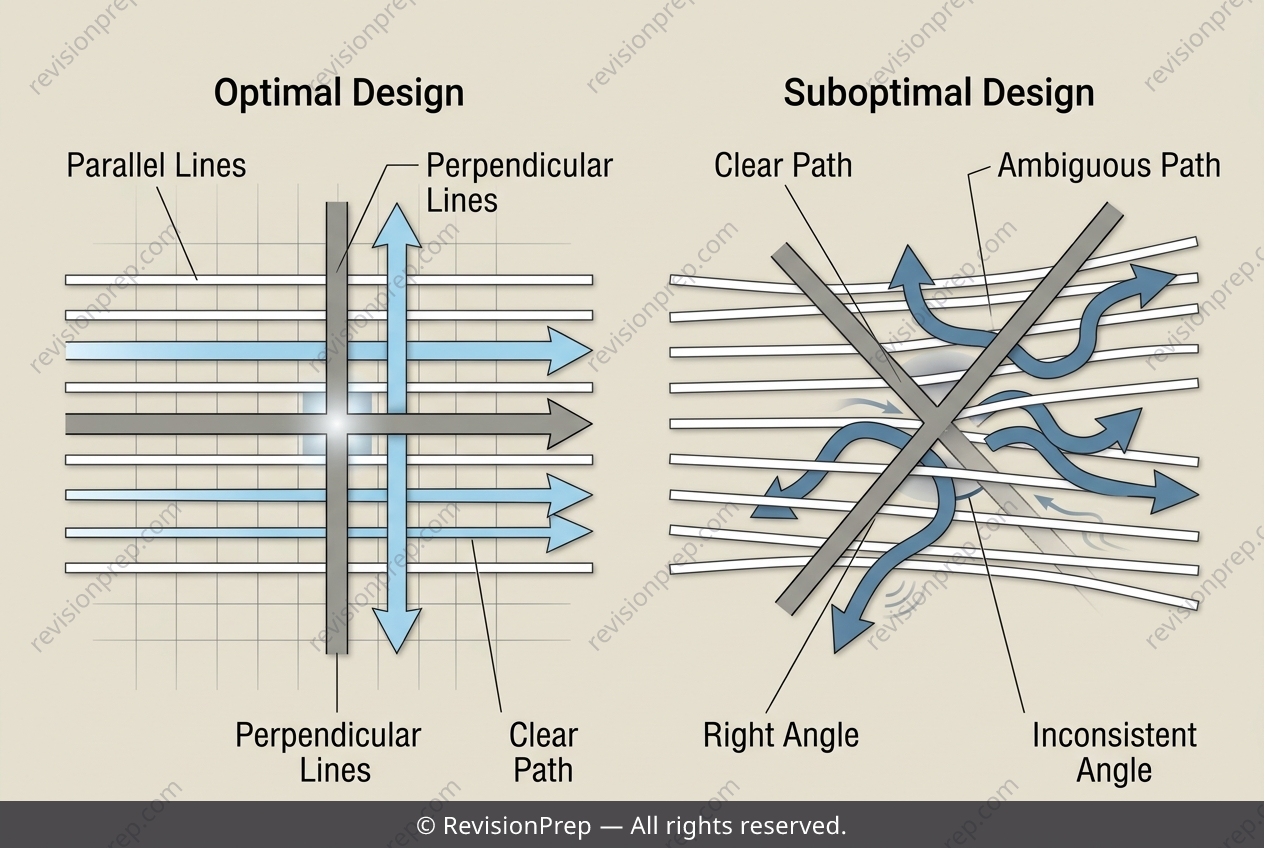
Geometry isn’t just about measuring shapes on a page—it’s the invisible language that keeps us safe in the physical world. In this topic, we explore lines, angles, and their properties, focusing on how parallel and perpendicular relationships govern design. When a city planner paints a crosswalk, they aren’t just making a pattern; they’re applying geometric principles to solve a real-world safety problem. The core idea is simple: parallel lines maintain a constant distance, while perpendicular lines meet at a 90° angle. In the crosswalk, parallel stripes guarantee a uniform width, creating a clear, predictable corridor that drivers and pedestrians can instantly recognise. Meanwhile, stripes perpendicular to the curb ensure the crossing path is the shortest possible straight line between two points. This minimises the time a pedestrian spends in traffic, directly reducing accident risk. These two conditions work together—uniformity for visibility, perpendicularity for efficiency—turning abstract angle rules into a life-saving design. Understanding why these properties matter connects pure mathematics to practical human outcomes.
Start practising IB questions today
150,000+ IB-styled questions, criteria-mapped and instantly accessible.