
Maths: The Geometry of Precision: Angles & Error
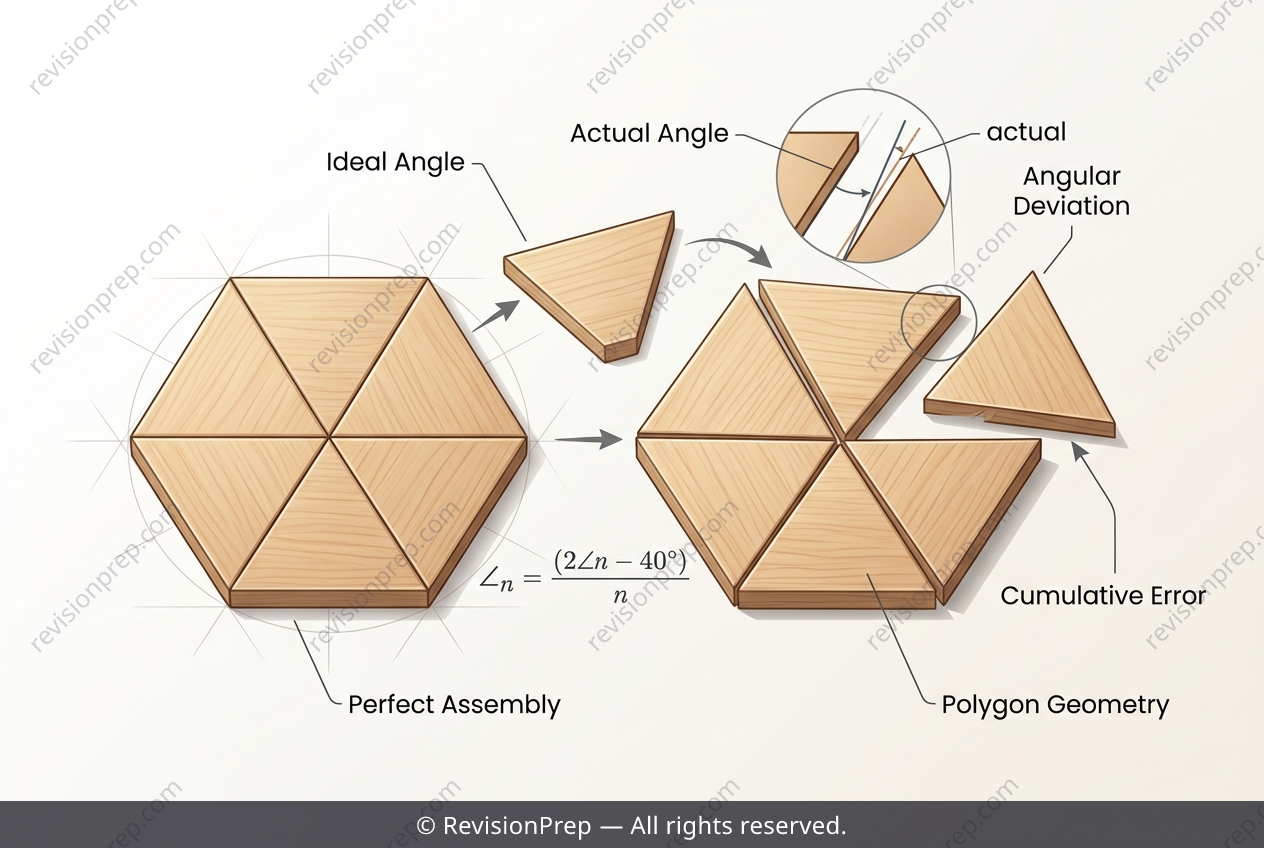
Geometry is the quiet engine behind every well-made object, and for IB students, few topics show this more clearly than the study of triangles, quadrilaterals, and polygons. At its heart lies a single powerful relationship: the interior angle sum formula, (n − 2) × 180°, which tells us how the angles inside any straight-sided shape are locked together. For a regular polygon—one with all sides and angles equal—this sum divides evenly among the sides, giving the exact angle for each corner. That precision is not just theoretical; it is the difference between a tabletop that fits seamlessly and one that wobbles or splits apart. The deeper idea here is cumulative error. When you make multiple cuts, each with a small measurement mistake, those tiny deviations do not cancel—they add up. A saw set to 120° for a hexagon, for instance, might actually cut at 119° or 121° due to a ±1° error. Across six pieces, that small per-cut error compounds into a total angle sum that is either too small (leaving gaps) or too large (causing overlaps). Understanding how the formula sets the target, and how real-world error shifts the total, connects abstract geometry to practical craftsmanship—and reveals why mathematical precision matters far beyond the page.
Start practising IB questions today
150,000+ IB-styled questions, criteria-mapped and instantly accessible.