
Maths: Triangle Angle Rules & Error Propagation
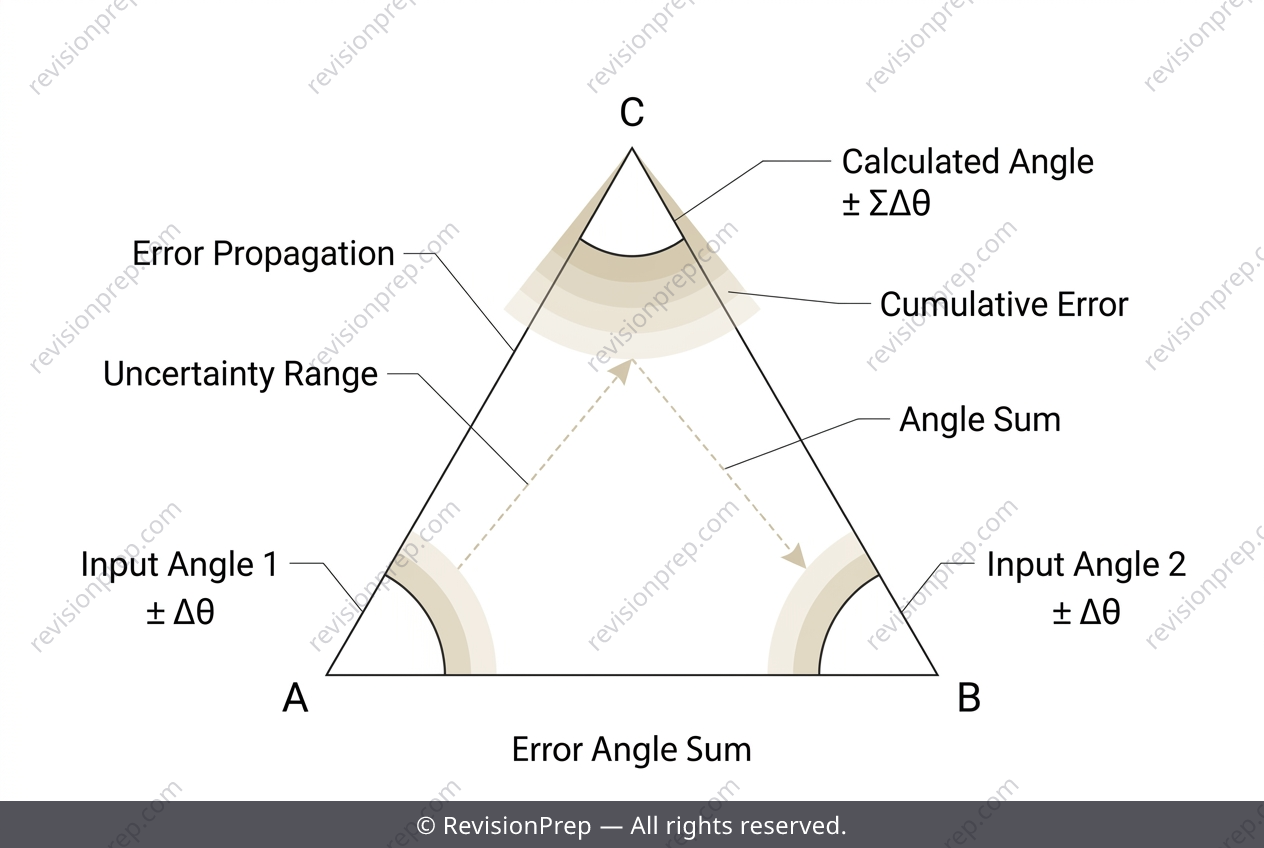
When a ship captain plots a course around a peninsula, the path often forms a triangle, and the angles within that triangle are not just abstract numbers—they are the difference between a safe passage and a navigational error. This topic introduces the fundamental rule that the interior angles of any triangle sum to 180°, a relationship that allows you to determine an unknown angle when the other two are known. However, the real-world challenge lies in the fact that no measurement is perfect. Every reading taken with a compass or sextant carries an inherent uncertainty, and this is where error propagation becomes essential. The core mechanism here is simple but powerful: when you calculate a third angle by subtracting two measured angles from 180°, the uncertainties in those measurements do not cancel—they accumulate. If each measured angle has an error of ±2°, then the maximum possible error in the computed third angle is the sum of those individual errors, yielding a combined uncertainty of ±4°. This means the true value of the third angle is not a single point but a range, bounded by the worst-case scenarios of both measurements. Understanding how these errors combine is what transforms a static geometric rule into a practical tool for assessing the reliability of any calculated result, whether in navigation, engineering, or pure mathematics.
Start practising IB questions today
150,000+ IB-styled questions, criteria-mapped and instantly accessible.