
Maths: Variable Representation and Algebraic Simplification in Word Problems
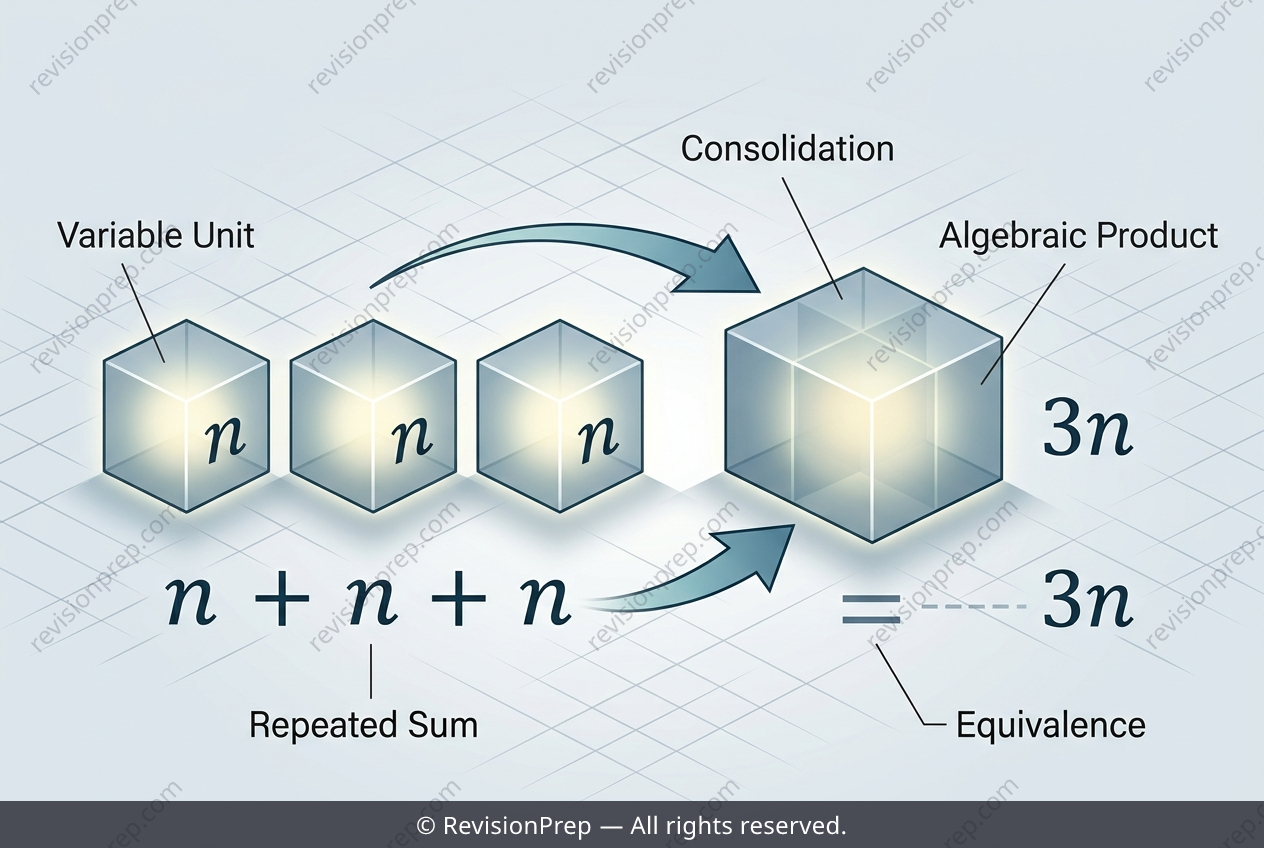
When you first meet algebra, it can feel like a whole new language—but really, it’s just a way to write down unknown numbers using letters. In this problem, the letter n is a variable, which simply means it stands for a value we don’t know yet. Here, n represents the number of apples in a single bag. That one small letter lets us talk about all three bags at once, without needing a specific number. The key idea is that repeated addition can be compressed into multiplication. If you have three bags, each with n apples, the total is n + n + n. But writing that out every time is clumsy. Instead, we use the shorter form 3n, which means “three groups of n.” Both expressions give the same total, but 3n is more efficient and shows the structure of equal groups at a glance. Understanding this connection—between repeated addition and multiplication—is the foundation for simplifying expressions and solving word problems later on. Once you see that a letter is just a placeholder, and that operations like multiplication can bundle repeated terms, algebra stops being mysterious and becomes a tool for clear, concise thinking.
Start practising IB questions today
150,000+ IB-styled questions, criteria-mapped and instantly accessible.