
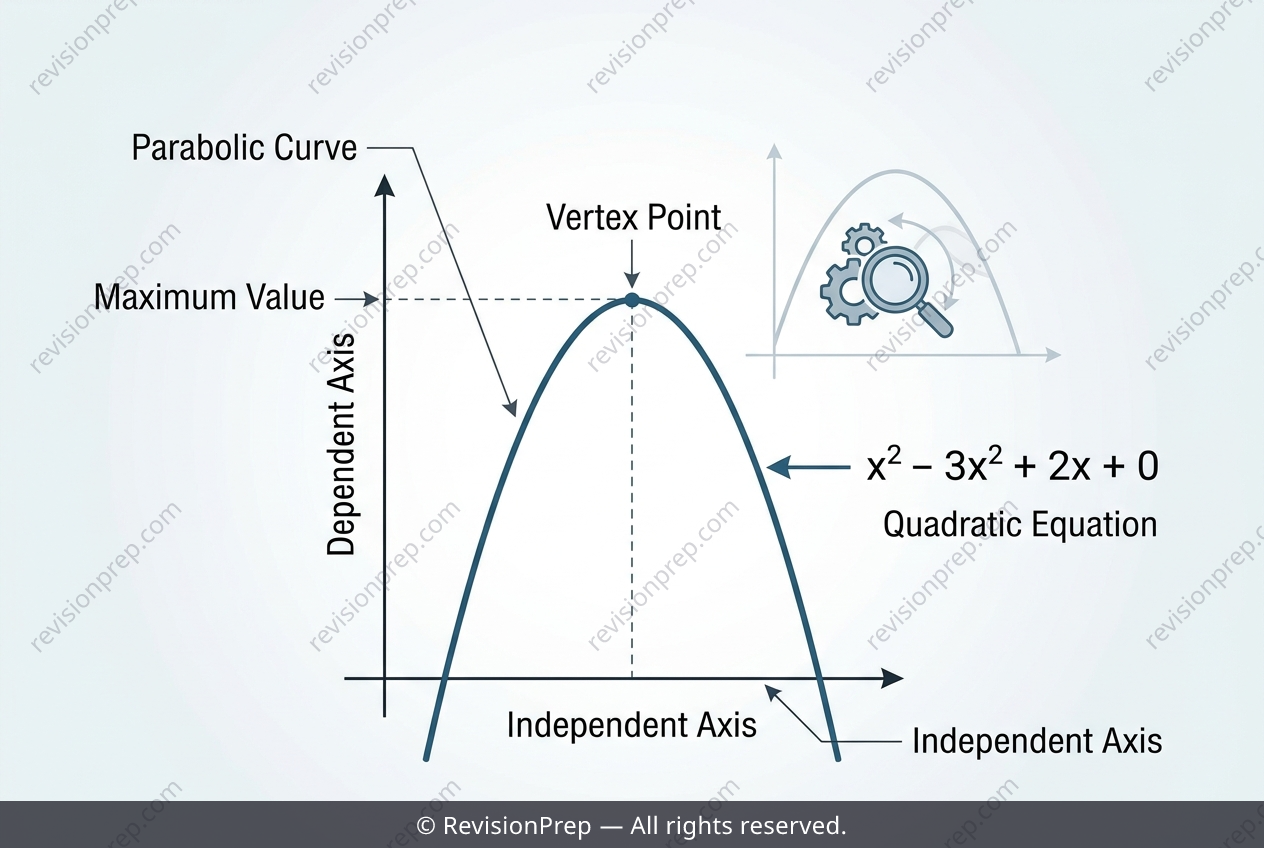
Maths: Vertex of Quadratic Functions with a Real Basketball Shot
The vertex of a quadratic function is the single point where its curve changes direction—either the highest or lowest value the function reaches. For any quadratic written in the form h(t) = at² + bt + c, the vertex occurs at t = -b/(2a), a formula that emerges directly from the symmetry of the parabola. This point is not just a geometric curiosity; it encodes the peak or trough of a real-world relationship, making it one of the most practical tools in applied mathematics. In contexts like projectile motion, the vertex reveals the instant of maximum height and that height itself. Here, the coefficient a being negative tells us the parabola opens downward, so the vertex is a peak. Substituting the vertex time back into the original equation gives the corresponding output value—the maximum height. However, a single quadratic only describes one dimension of motion. While it can confirm whether an object reaches a certain vertical threshold, it says nothing about horizontal position, meaning a complete answer must acknowledge what the model cannot capture. Understanding this distinction between mathematical result and physical conclusion is central to interpreting quadratics meaningfully.
Start practising IB questions today
150,000+ IB-styled questions, criteria-mapped and instantly accessible.