
Maths: Word Problems: Modeling Costs with Domain Constraints
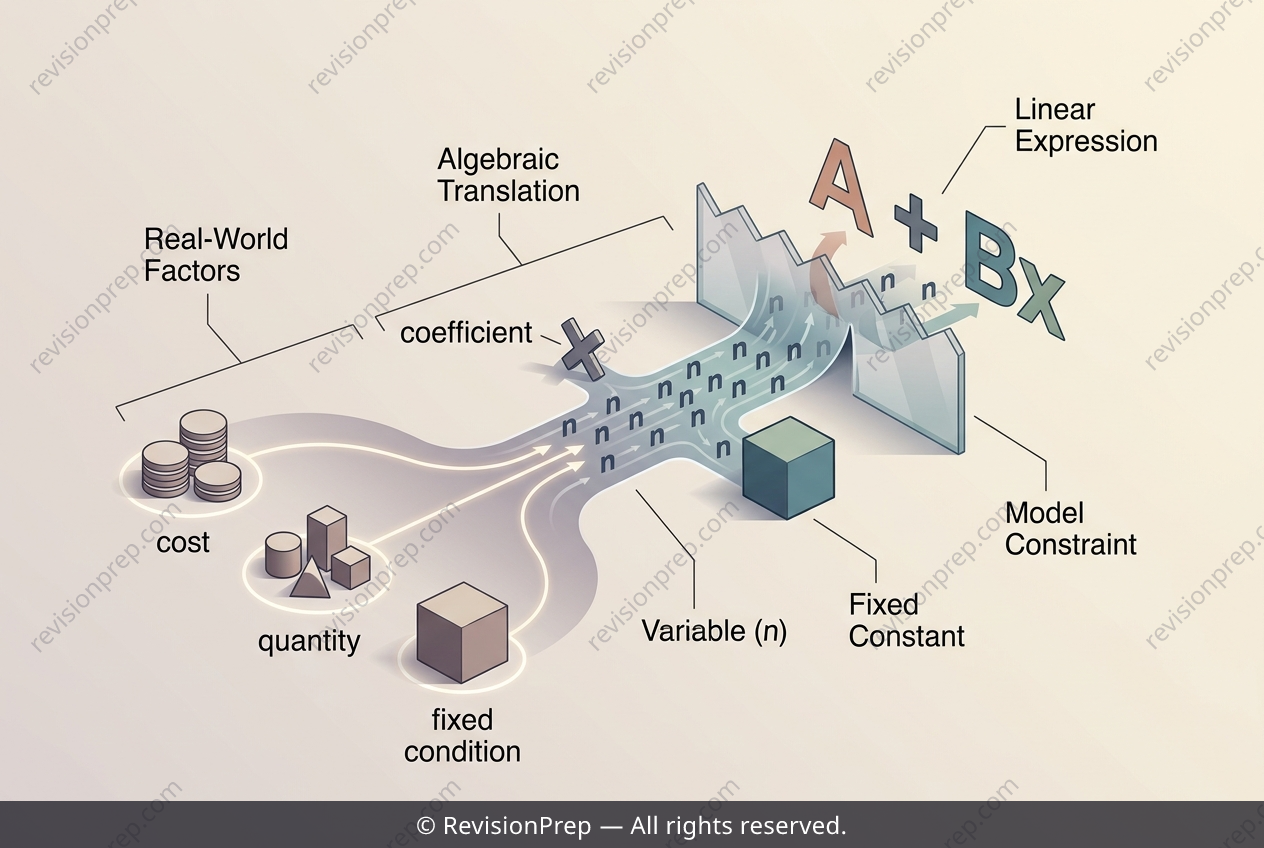
Word problems are really just mathematical models in disguise—translating a real-world situation into an algebraic expression that can be manipulated and evaluated. In this case, a school trip’s total cost is built from two distinct sources: a fixed bus rental fee plus a per-student charge, and a separate per-student admission fee. The core skill is recognizing how these parts combine into a single linear expression, here of the form 150 + 10n, where n represents the number of students. This structure—one constant term plus one variable term—is the backbone of many practical models. What makes this concept powerful is that it forces you to respect the domain of the model. The bus holds at most 40 students, so the expression is only valid for n ≤ 40. Beyond that, the model breaks down because the fixed cost would no longer be a single bus rental—you’d need another bus, adding a new fixed fee and changing the per-student rate. This is the essence of mathematical modeling: not just writing an equation, but understanding its limits and how changes to the input parameters (like a fee increase or decrease) reshape the entire expression, as seen when the fixed fee rises and the per-student fee falls, altering both the intercept and the slope of the cost function.
Start practising IB questions today
150,000+ IB-styled questions, criteria-mapped and instantly accessible.