
Maths: Why Plant Height Has Infinite Possible Values
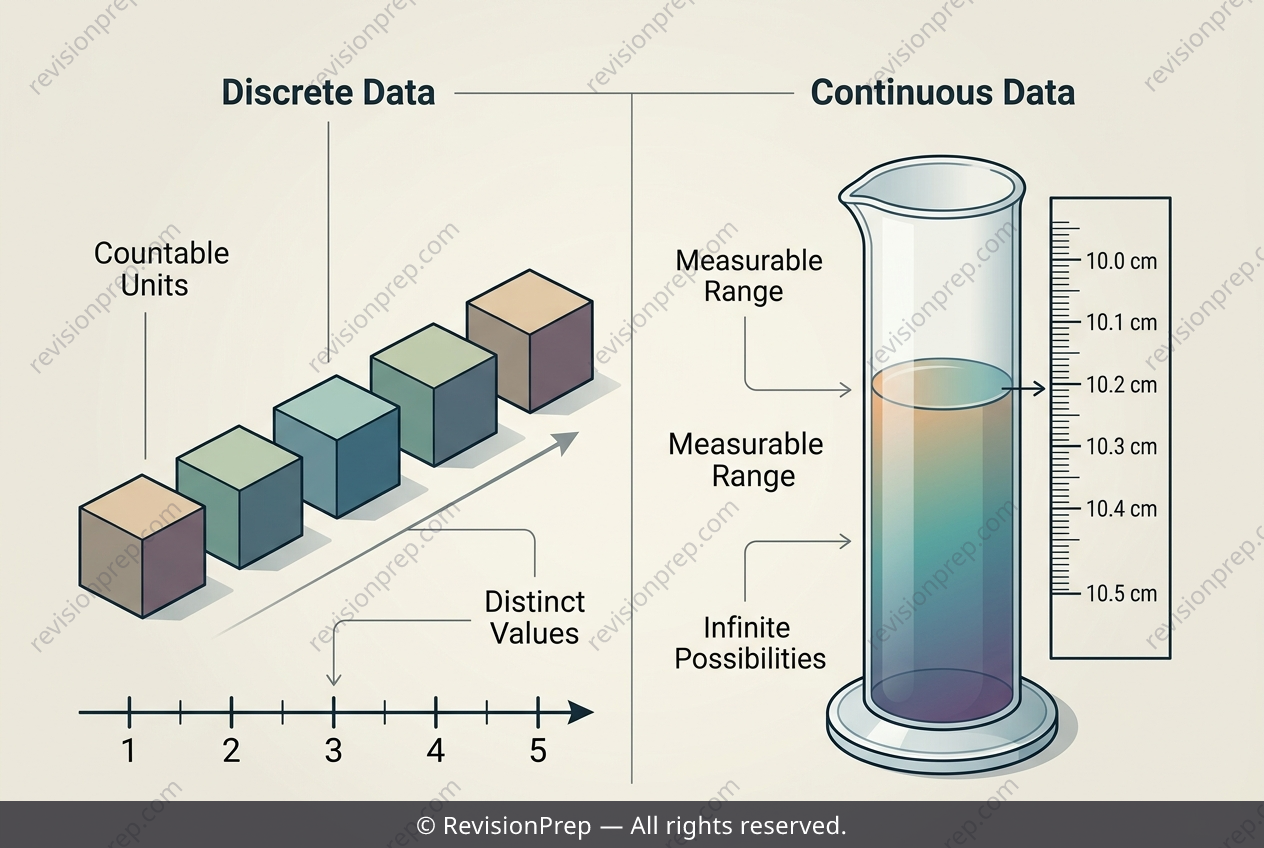
In the study of mathematics, data is broadly classified into two fundamental types: discrete and continuous. Discrete data arises from counting, meaning it can only take specific, separate values—typically whole numbers. In contrast, continuous data arises from measuring, meaning it can take any value within a given range, limited only by the precision of your measuring instrument. Understanding this distinction is crucial because it dictates which statistical tools and graphical representations are appropriate for analysis. For instance, while you can count the number of students in a class (a discrete set of whole numbers), you cannot count the possible heights of a plant. Height is continuous because it exists on a spectrum—a plant might be 12 cm, 12.4 cm, or 12.47 cm tall, with infinitely many possibilities in between. The key relationship is that discrete data is counted, whereas continuous data is measured, and this measuring process allows for an endless degree of refinement, connecting the concept of precision directly to the nature of the data itself.
Start practising IB questions today
150,000+ IB-styled questions, criteria-mapped and instantly accessible.