
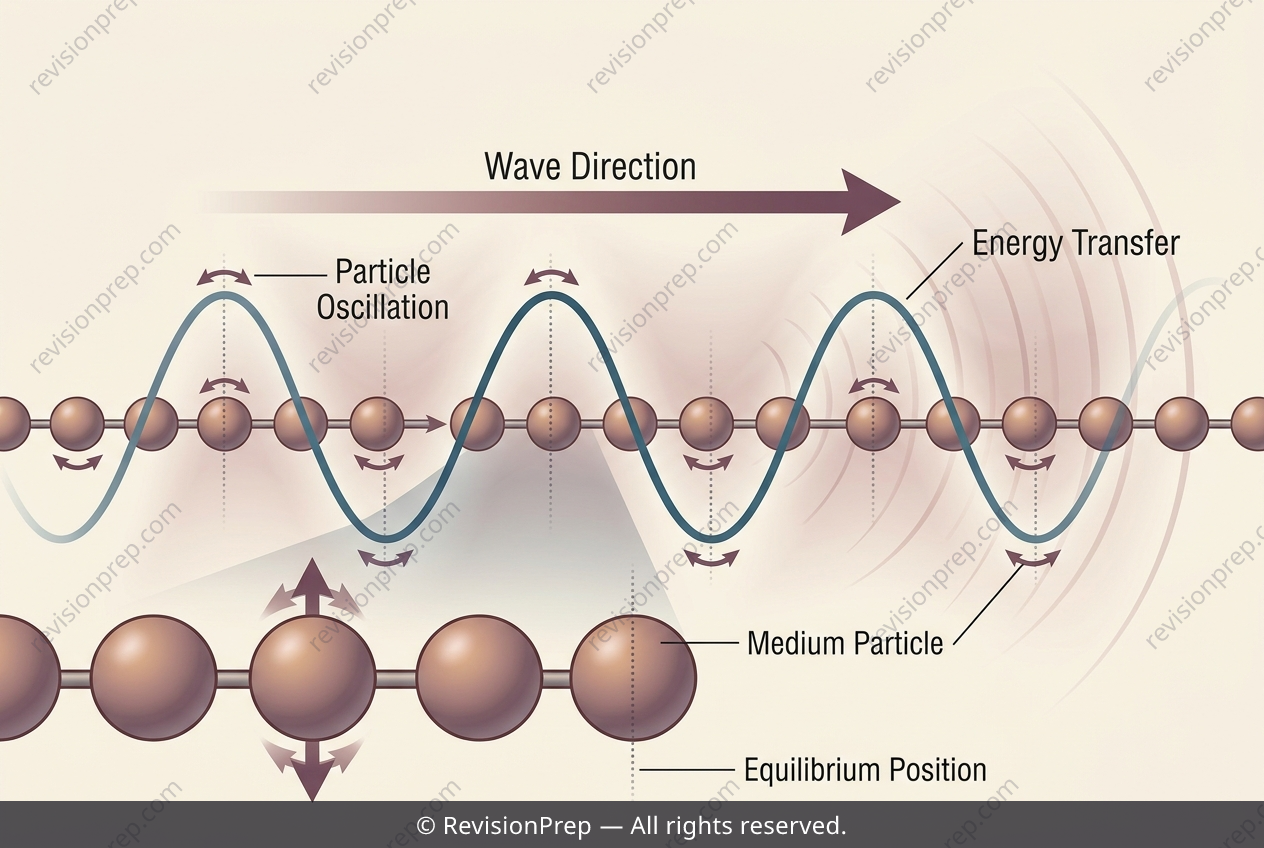
Physics: A Ripple's Secret — Energy, Not Matter
When you drop a stone into a still pond, the ripples that spread outward are a perfect, everyday demonstration of one of the most elegant ideas in physics: wave motion. At its heart, a wave is a disturbance that travels through a medium, and its defining feature is that it carries energy from one location to another without carrying the medium itself along for the ride. This single principle—energy transfer without net matter transport—underpins everything from sound travelling through air to light crossing the vacuum of space. To grasp this, picture the water molecules in the pond. As the ripple passes, each molecule merely oscillates around its own fixed position, moving up and down (or in small circles) but never travelling outward with the wave. What actually moves outward is the pattern of disturbance, which carries the kinetic and potential energy of the initial impact. The wave transfers energy, while the matter (the water, or any other substance) stays put. This distinction is fundamental: it explains why a cork bobs on the surface rather than being swept to the shore, and why the energy of a wave can be harnessed far from its source.
Start practising IB questions today
150,000+ IB-styled questions, criteria-mapped and instantly accessible.