
Physics: How a Slinky Wave Moves Without Moving Matter
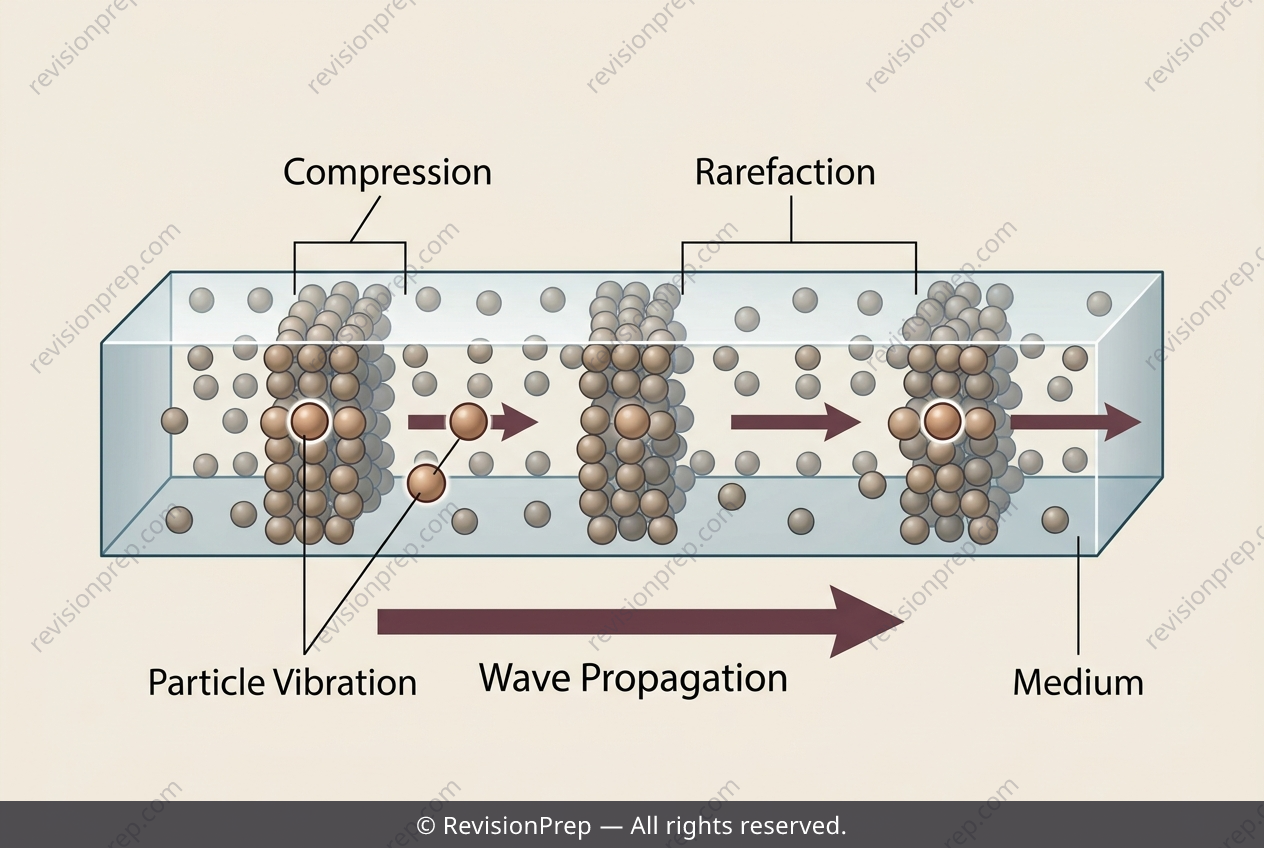
When you push and pull a slinky, you are not sending matter down its length—you are sending energy. The wave you create is a longitudinal wave, where the disturbance travels parallel to the direction of energy transfer. As your hand vibrates back and forth, it forces the coils to bunch together and then stretch apart, creating two distinct regions: compressions (where coils are squashed close) and rarefactions (where coils are spread far apart). These alternating regions are the physical signature of the wave, and they move along the slinky even though the individual coils only oscillate around their resting positions. This concept matters because longitudinal waves are everywhere—from sound travelling through air to seismic P-waves shaking the ground. The key relationship is that the wave’s speed depends on the medium’s properties, not on the hand’s motion, and is given by v = fλ, where frequency and wavelength are inversely linked. Understanding compressions and rarefactions helps you visualise how pressure variations carry energy, and why the coils’ vibration (back-and-forth motion parallel to the wave’s travel) is what transfers the disturbance—not the movement of the medium itself.
Start practising IB questions today
150,000+ IB-styled questions, criteria-mapped and instantly accessible.