
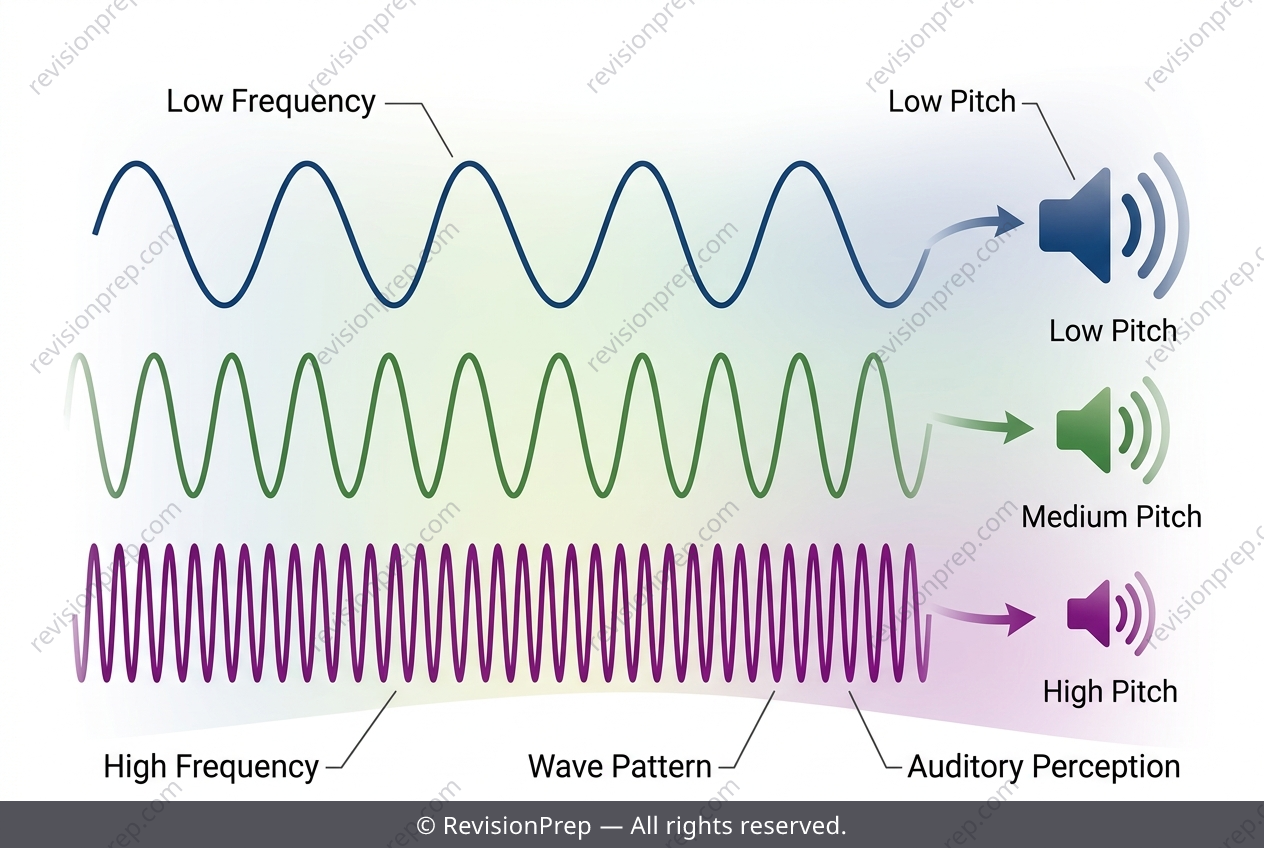
Physics: How Frequency Becomes Pitch
When you pluck a guitar string, the sound you hear isn’t just a single “note”—it’s a physical wave travelling through the air, and its shape holds the key to how your brain perceives it. The core relationship here is between frequency (how many complete wave cycles pass a point each second, measured in hertz) and pitch (how “high” or “low” a sound seems to you). Simply put, frequency is the physical property of the wave, while pitch is the psychological sensation it creates. This connection matters because it underpins everything from music and speech to medical ultrasound and animal communication. A low-frequency wave (like a deep drumbeat) has few cycles per second, producing a low pitch, whereas a high-frequency wave (like a whistle) packs many cycles into the same time, producing a high pitch. In the classic wave diagram, you’d see that the wave with the most tightly packed peaks—the one with the shortest wavelength—corresponds to the highest frequency and therefore the highest pitch. The relationship is direct and linear: double the frequency, and you perceive a pitch that is one octave higher. Understanding this mapping between a measurable wave property and a subjective experience is the first step to mastering how sound works.
Start practising IB questions today
150,000+ IB-styled questions, criteria-mapped and instantly accessible.