
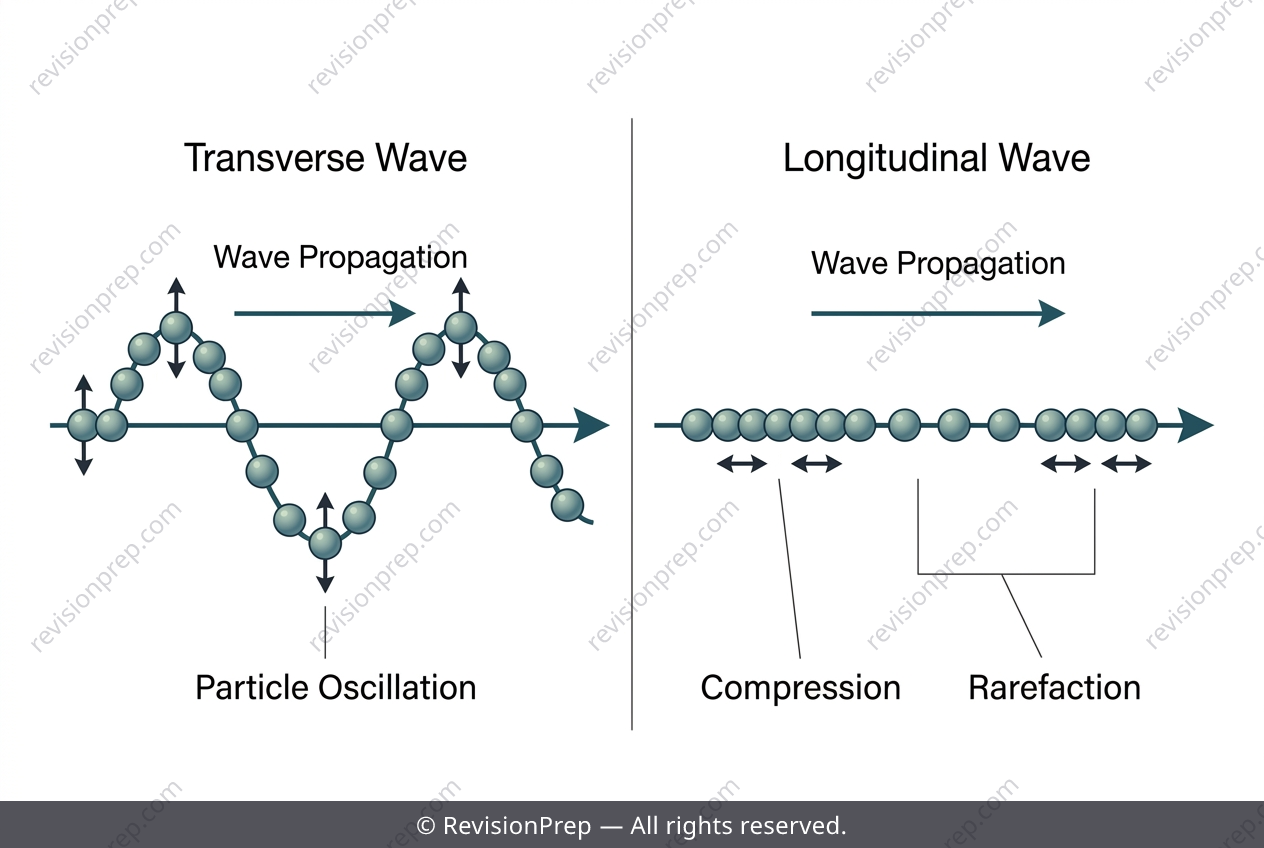
Physics: How Particle Motion Defines a Wave
Waves are all around us, but they don’t all move the same way. When Maria shakes a jump rope, the rope’s segments travel up and down while the wave itself moves horizontally along the rope. When she drops a ball into a bathtub, the water surface ripples outward, with each water particle bobbing up and down as the wave spreads. These two examples share a key trait: the disturbance moves perpendicular to the wave’s direction of travel. That makes them transverse waves. But clapping your hands tells a different story. The sound wave that reaches your friend is a longitudinal wave: the air molecules compress and rarefy, moving back and forth along the same line the sound travels. No up-and-down motion is involved. Understanding this distinction matters because it explains how energy transfers through different media—from ropes and water to air and even solids. The wave speed, frequency, and wavelength (v = fλ) apply to both types, but the particle motion defines the category. So while the rope and water move perpendicular, the air in a sound wave moves parallel—two fundamentally different mechanisms for carrying energy.
Start practising IB questions today
150,000+ IB-styled questions, criteria-mapped and instantly accessible.