
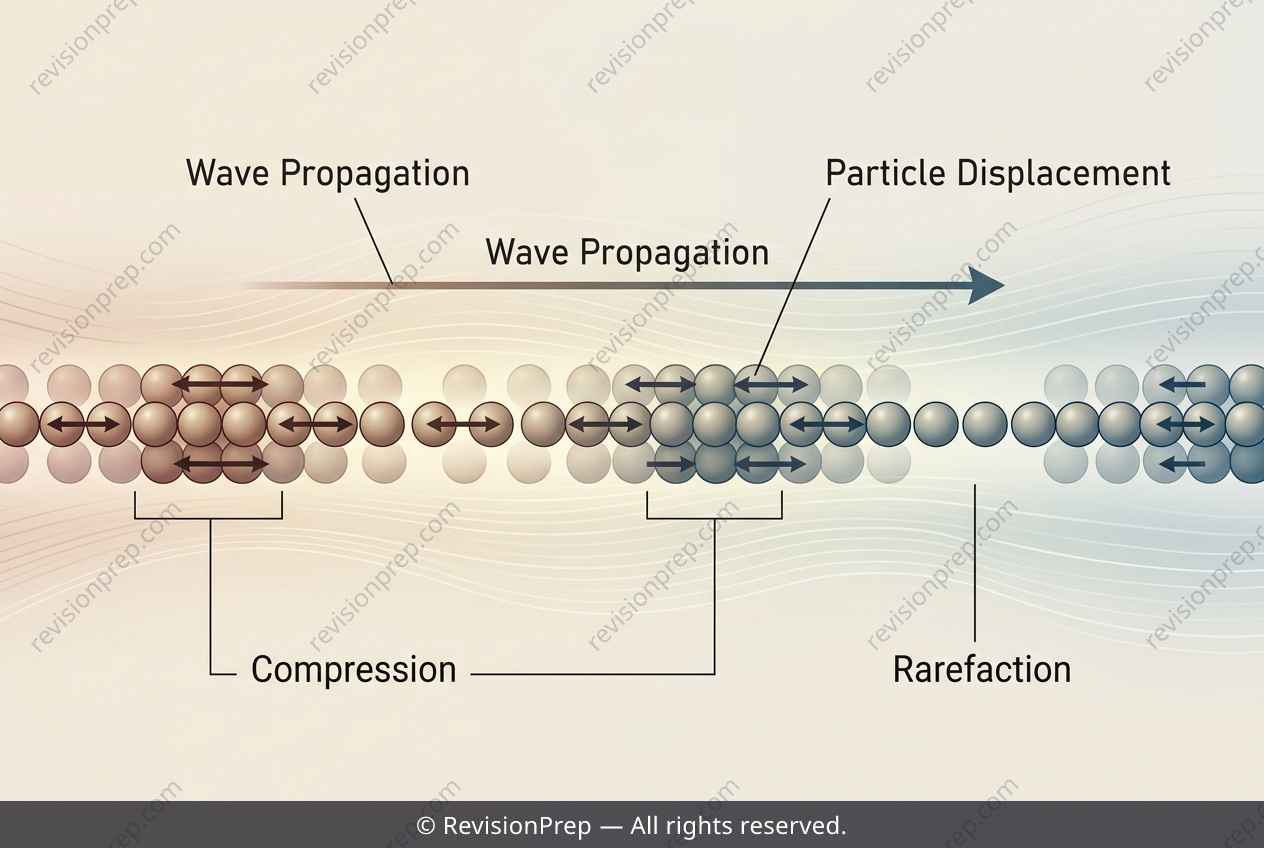
Physics: How Sound Squeezes and Stretches the Air
Longitudinal waves are all about energy moving through a medium by pushing and pulling particles back and forth along the same direction the wave travels. Unlike transverse waves, where particles move perpendicular to the wave’s path, a longitudinal wave creates alternating regions of compression—where particles bunch together—and rarefaction, where they spread apart. This is the core mechanism behind sound travelling through air, or a pulse moving down a slinky. Understanding how these regions form is essential for interpreting wave diagrams and predicting how energy transfers without net particle movement. In a slinky, a compression appears where the coils are tightly packed, while a rarefaction shows coils stretched far apart. These two features always alternate, and their spacing relates to wavelength, while the speed of the wave depends on the medium’s properties—often expressed as v = fλ. Recognising compressions and rarefactions on a diagram is the first step to linking particle oscillation to wave propagation, a key skill for analysing any longitudinal wave.
Start practising IB questions today
150,000+ IB-styled questions, criteria-mapped and instantly accessible.