
Physics: How Your Eardrum Turns Sound into Vibration
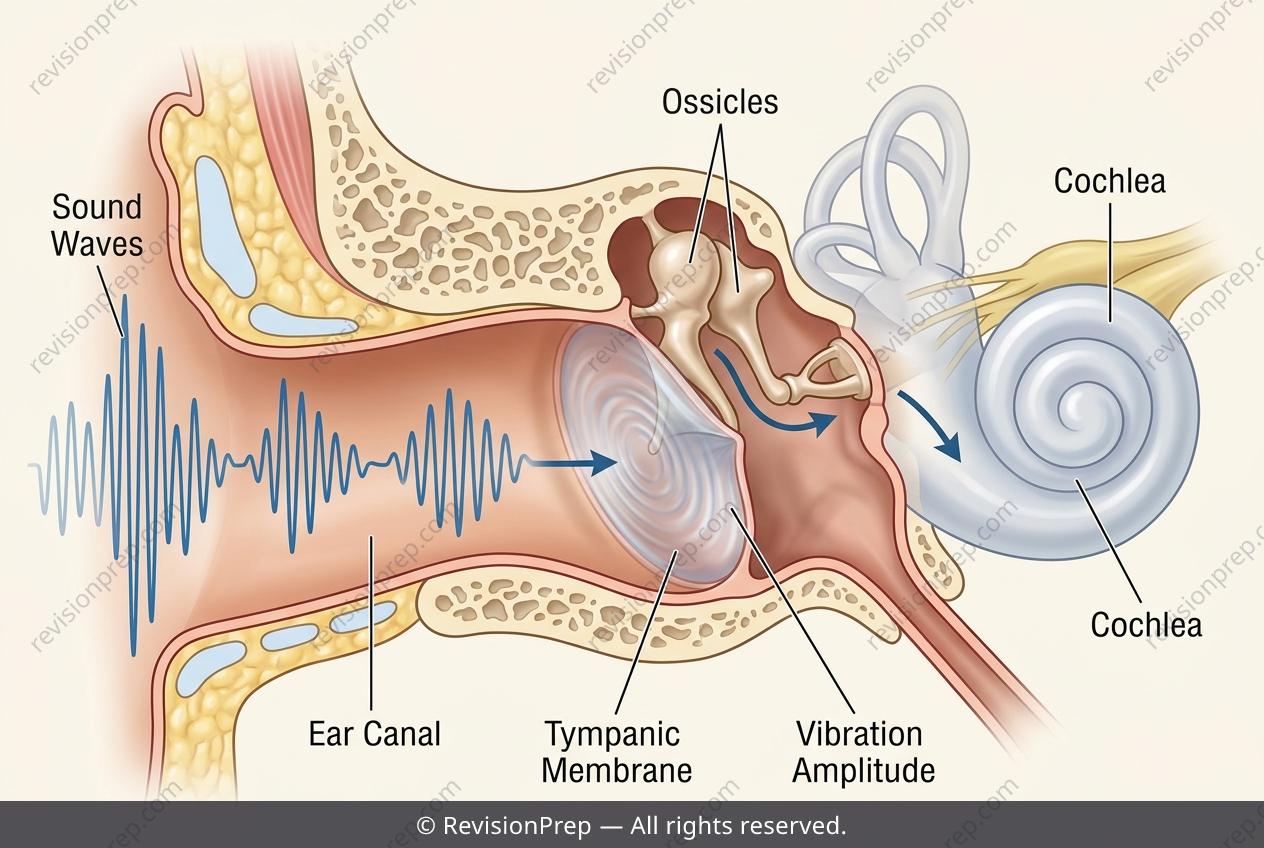
Sound is a mechanical wave—a ripple of pressure travelling through air—and your ear is a precision instrument built to catch it. At the heart of this process lies the eardrum, a thin membrane that vibrates in response to incoming sound waves. Its movement is the first step in auditory transduction, converting invisible acoustic energy into physical motion. The amplitude of these vibrations directly encodes loudness: a quiet sound nudges the eardrum gently, while a loud sound forces it to oscillate with far greater back-and-forth displacement. This mechanical signal then travels through the middle ear bones to the cochlea, where it is finally translated into neural impulses for the brain to interpret. Understanding this chain matters because it explains why intensity, not just frequency, shapes what we hear. The eardrum’s response is proportional to the sound wave’s pressure amplitude—think of it as the physical equivalent of wave energy, where greater amplitude means stronger vibration. Without this initial mechanical amplification, the delicate hair cells in the cochlea would never receive enough stimulation to fire. So, when you trace a sound from the ear canal to the eardrum and onward, you are following a story of energy transfer: from pressure variation to membrane motion, then to fluid waves and electrical signals—each step preserving the information about how loud the world around you truly is.
Start practising IB questions today
150,000+ IB-styled questions, criteria-mapped and instantly accessible.