
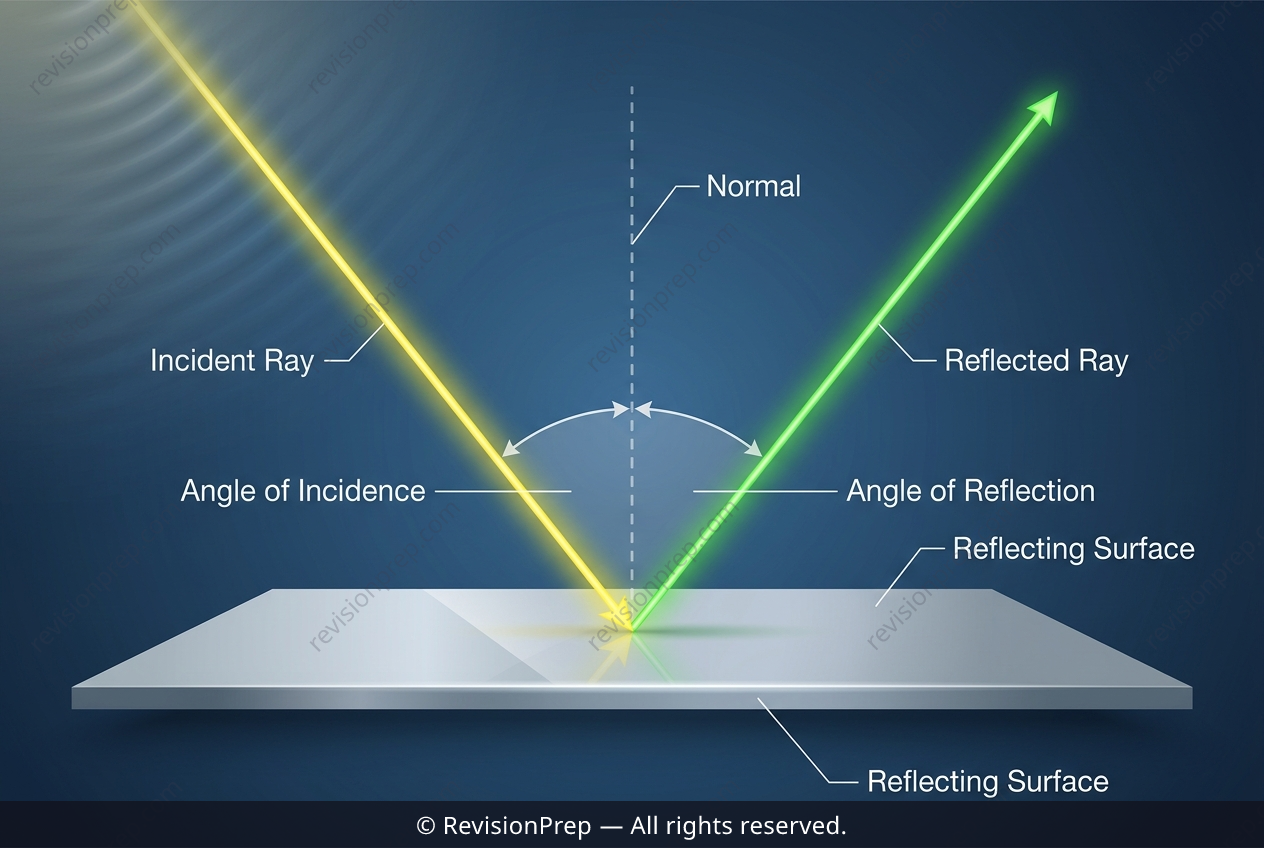
Physics: The Normal Line That Shapes Reflection
Reflection is one of the most intuitive yet foundational behaviours of waves, and the law of reflection governs how light (or any wave) bounces off a surface. At its heart, the law states that the angle of incidence equals the angle of reflection, with both angles measured relative to the normal—an imaginary dashed line drawn perpendicular to the surface at the point of impact. This simple equality, θᵢ = θᵣ, is not just a rule to memorise; it explains everything from why you see your face in a mirror to how periscopes and optical fibres redirect light. What makes this concept elegant is the geometry hidden in plain sight. The normal line acts as the reference axis, splitting the incoming and outgoing rays into two symmetric halves. When a ray strikes a flat mirror, the incident ray, the reflected ray, and the normal all lie in the same plane, and the reflected ray leaves the surface on the opposite side of the normal. The angle of reflection is always measured from the reflected ray back to the normal—never from the surface itself. This distinction is crucial because confusing the normal with the surface plane is a classic pitfall. By visualising the normal as a mirror’s “spine,” you can predict the path of any reflected wave, whether it’s light, sound, or water ripples.
Start practising IB questions today
150,000+ IB-styled questions, criteria-mapped and instantly accessible.