
Physics: Why Sound Travels Faster Through Solids
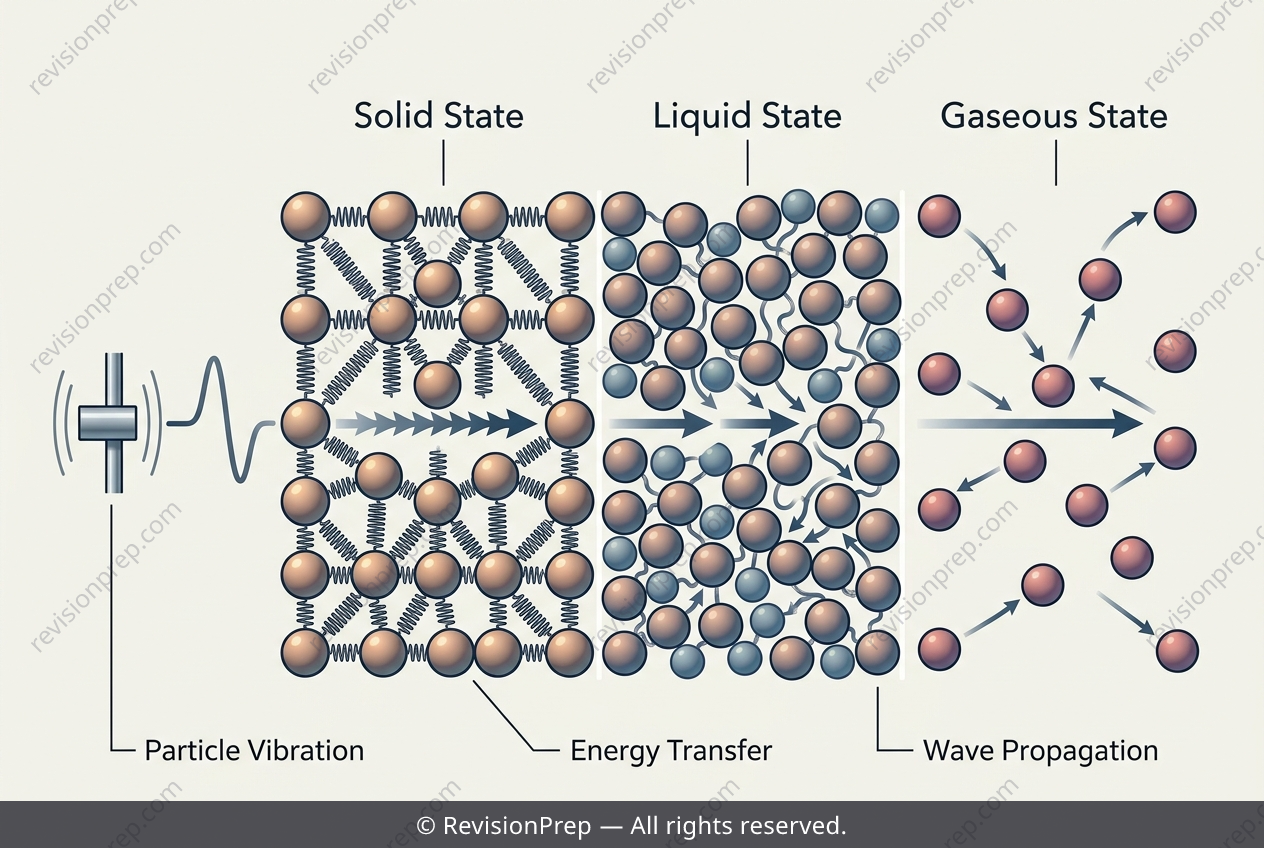
When a sound source vibrates, it sends energy through a medium by making particles collide with their neighbours. The speed of that energy transfer is not fixed—it depends entirely on how the particles are arranged and how strongly they interact. In this topic, you’ll explore why sound travels at very different speeds through solids, liquids, and gases, and how the microscopic structure of matter dictates the macroscopic behaviour of waves. The key relationship is simple: the closer the particles, the faster the vibration passes along. In a solid, particles are locked in a tight, orderly lattice with strong intermolecular forces, so a push at one end is felt almost instantly at the other. In a liquid, particles are still close but can slide past each other, slowing the transfer. In a gas, particles are far apart and collisions are rare, making sound the slowest. This is why the speed of sound (v) relates to the medium’s elasticity and density—not just the wave’s frequency or wavelength (v = fλ). Understanding this particle-level mechanism explains everything from why you hear a train through the rails before the air, to how sonar works in water.
Start practising IB questions today
150,000+ IB-styled questions, criteria-mapped and instantly accessible.