
Physics: Why Sound Travels Four Times Faster in Water
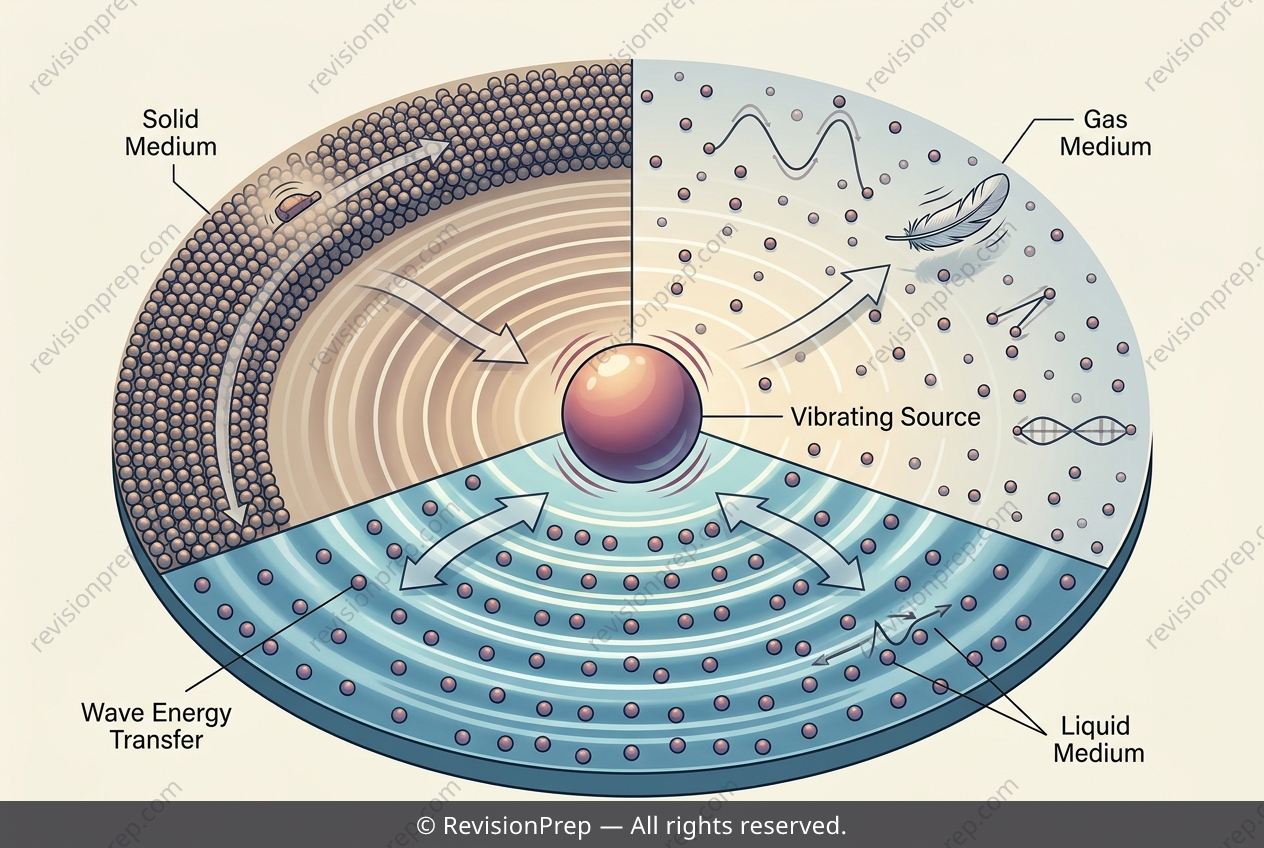
Sound is a mechanical wave, meaning it cannot travel through a vacuum—it needs a medium of particles to carry its energy. Whether that medium is a solid, liquid, or gas fundamentally changes how the wave behaves, because the spacing and bonding between particles dictate how quickly and efficiently vibrations are passed along. In this exploration, we see sound moving through both a liquid (water in a glass) and a gas (air around a candle flame), highlighting that the same physical principle—particle-to-particle collision—operates differently depending on the material’s density. The key relationship here is that the speed of sound depends on how tightly packed the medium’s particles are. In water, molecules sit close together, so a vibration from a tuning fork pushes neighbouring particles almost instantly, creating visible ripples with little energy loss. In air, particles are far apart, so they must travel further to bump into each other, slowing the wave’s progress and making its effects—like flickering a flame—more subtle. This contrast reveals why sound travels roughly four times faster in water than in air, and why the same source can produce dramatically different physical responses in different states of matter.
Start practising IB questions today
150,000+ IB-styled questions, criteria-mapped and instantly accessible.