
Physics: Why the Cork Never Reaches the Shore
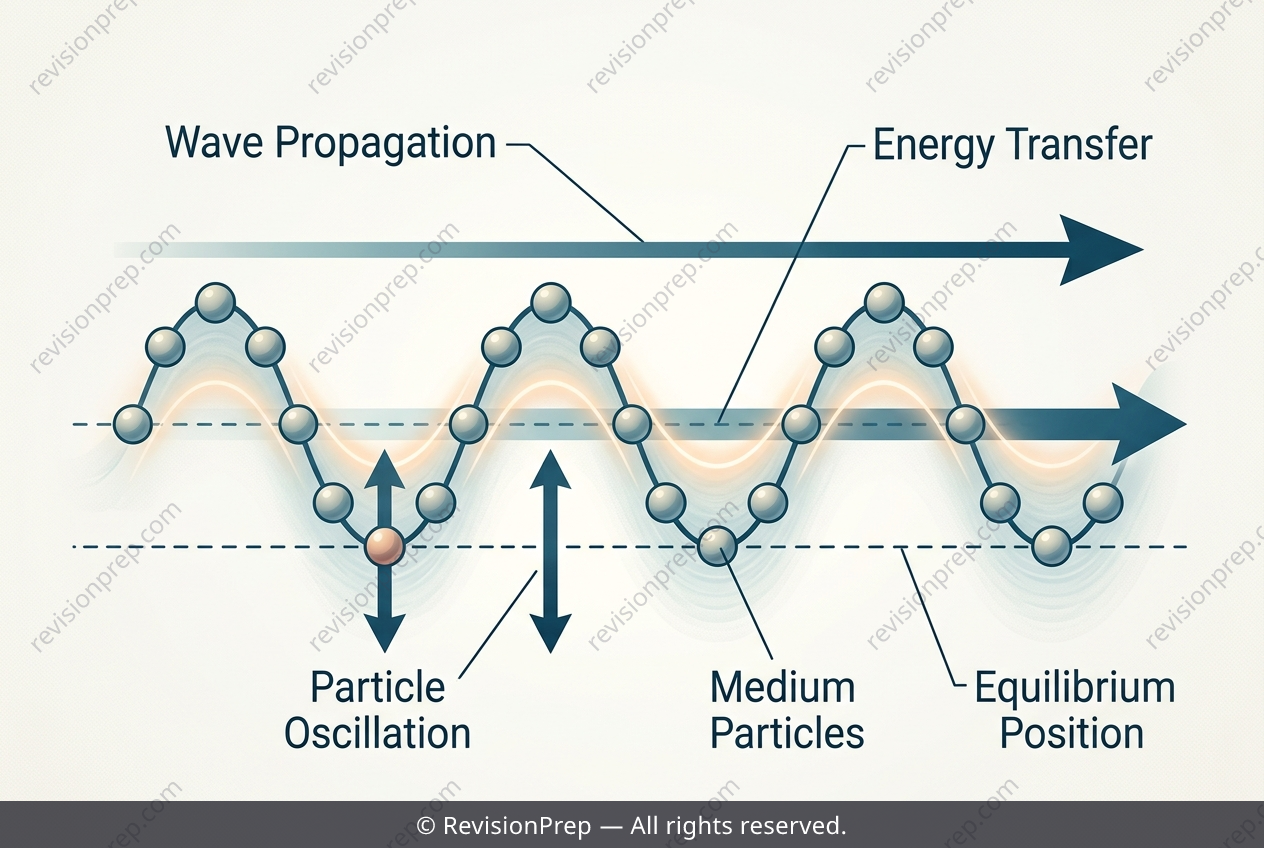
When ripples spread across a pond, a floating cork bobs up and down in place—it doesn’t drift toward the shore. This simple observation reveals a fundamental idea: a wave transfers energy from one location to another, but it does not transfer matter. The water particles themselves mostly oscillate around fixed positions, passing their motion to neighbours, while the energy travels outward. This distinction between energy movement and particle movement is the heart of understanding wave behaviour, whether in water, sound, or light. The cork’s vertical rise and fall, while its horizontal position stays constant, shows that the medium (the water) is not carried along with the wave. A nearby leaf behaves identically, bobbing up and down without moving sideways. Both objects respond to the local oscillation of water particles, which move perpendicular to the wave’s direction of travel in this case. The key relationship is that the wave’s speed, frequency, and wavelength (v = fλ) describe the energy transfer, while the particles’ displacement remains limited to small vibrations. Because energy—not matter—is what propagates, the cork and leaf stay anchored in their spots, even as the ripple’s energy passes through them.
Start practising IB questions today
150,000+ IB-styled questions, criteria-mapped and instantly accessible.